
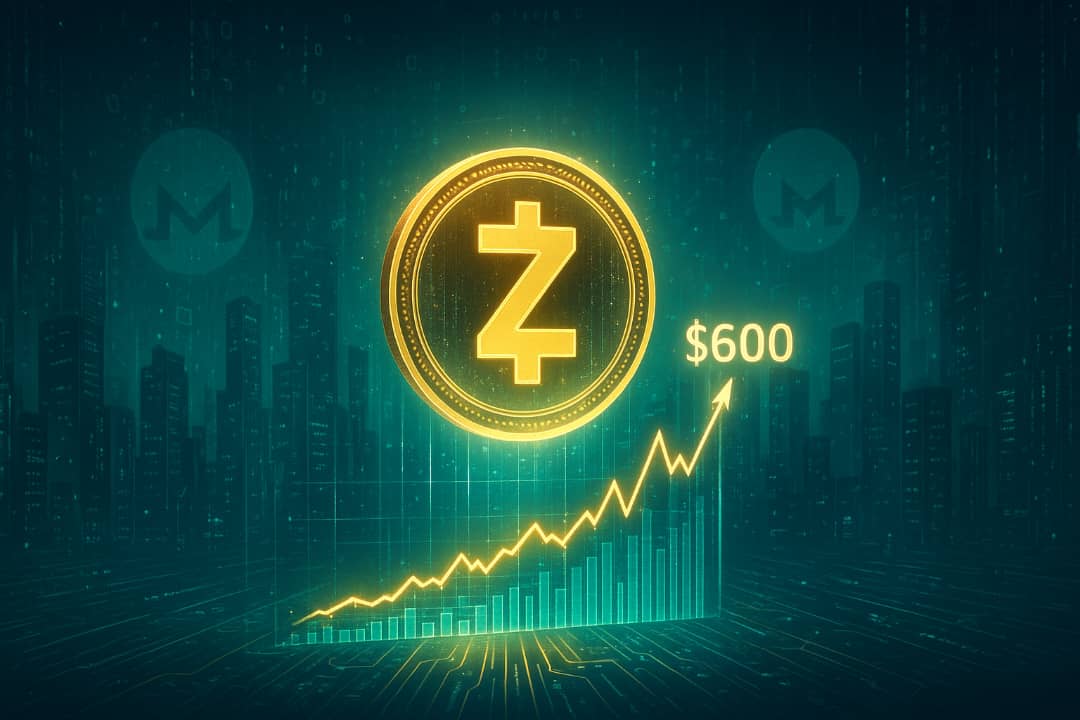
Zcash is back in the spotlight. The privacy-focused cryptocurrency, known by its ticker $ZEC, just crossed $600, a level not seen since January 2018.
The surge marks a powerful comeback for one of the earliest zero-knowledge projects in crypto, and a potential turning point for privacy tokens.
JUST IN: $ZEC breaks above $620 to hit a market cap of $10B.
It is now among the top 20 cryptocurrencies by market cap.
View chart: https://t.co/J3CHantXGF pic.twitter.com/As0NnhVGbD
— CoinGecko (@coingecko) November 7, 2025
Zcash Soars 1,400% in Two Months
ZEC has been unstoppable over the past few weeks. According to CoinMarketCap data, the token climbed from $40.42 on September 1 to $619 at the time of writing, a 1,431% gain in just two months.
The rally adds up to more than 15x growth in three months, giving Zcash a market capitalization of $10.2 billion. That pushes it to 13th place among the largest cryptocurrencies in the world.
Zcash has also become the face of the ongoing privacy-coin rally, outpacing competitors like Monero and Firo. Over the past 24 hours alone, ZEC jumped 21%, adding another billion dollars to its valuation.
Hoskinson Joins the Conversation
The latest breakout caught the attention of Cardano founder Charles Hoskinson, who weighed in on X (formerly Twitter).
Hoskinson retweeted a post from user Rashid bin Saeed, who had urged traders:
“Don’t fade privacy coins.”
Hoskinson’s short reply, “Midnight :)”, immediately went viral.
The comment was a nod to Cardano’s upcoming zero-knowledge sidechain “Midnight,” designed to blend privacy with compliance. It’s a subtle reminder that while Zcash pioneered the concept of zero-knowledge proofs, the next generation of blockchains is building on its foundation.
Hoskinson’s post effectively tied Cardano’s roadmap to the broader privacy narrative, and gave Zcash another wave of visibility among retail traders.
Midnight 🙂 https://t.co/k2MYBoqJ48
— Charles Hoskinson (@IOHK_Charles) November 7, 2025
The Long Road to $600
Zcash’s story goes way back. It started as a research paper called “Zerocash” in 2013, written by cryptographers from Johns Hopkins University.
The paper proposed an evolution of Bitcoin, one that would allow transactions to remain verifiable but private. That concept became the Electric Coin Company (ECC), founded by Zooko Wilcox and his team.
In October 2016, after the now-legendary “trusted setup ceremony,” Zcash launched its mainnet. Six participants destroyed cryptographic material known as “toxic waste” to ensure no one could counterfeit coins.
It was one of crypto’s earliest experiments in verifiable privacy.
2017–2018: The First Wave
By 2017, Zcash had a growing community and its own non-profit, the Zcash Foundation, focused on grants and community governance.
That year, the Overwinter and Sapling upgrades rolled out, making shielded transactions faster and more lightweight. Sapling, launched in October 2018, reduced proof size by 90%, allowing private payments on mobile wallets for the first time.
ZEC reached over $800 in its early peak. Then the bear market hit, and Zcash faded from the mainstream conversation.
2019–2020: Rebuild and the First Halving
In 2019, the Blossom upgrade cut block times from 150 to 75 seconds, making the network faster. ECC rebranded to clarify its mission: building technology, not just maintaining a token.
The first halving arrived in November 2020, reducing block rewards to 3.125 ZEC. The project’s monetary policy mirrored Bitcoin’s, but its privacy mission kept it in a category of its own.
2021–2022: Halo and the End of Trust
Trusted setups were always controversial. Zcash’s next breakthrough, Halo 2, changed that.
Halo 2 introduced recursive zero-knowledge proofs that no longer required any trusted ceremony. It made Zcash one of the first major chains with production-grade privacy proofs, no setup, no secrets, just math.
This leap forward positioned ZEC as the blueprint for decentralized privacy.
2023–2024: Pressure, Hash Power, and Another Halving
The next test came in 2023. Mining pool ViaBTC temporarily gained more than 50% of Zcash’s hash rate, sparking decentralization concerns.
Coinbase responded by increasing required confirmations for ZEC deposits. Conversations around regulation, delistings, and chain surveillance began to weigh on the project.
Still, Zcash persisted.
On November 23, 2024, the second halving (NU6) cut rewards again, to 1.5625 ZEC per block, and extended the Dev Fund to 2028. This ensured the ECC, Zcash Foundation, and grants ecosystem could keep building.
2025: Zashi, Shielded Explosion, and the Privacy Comeback
Then came Zashi, the new mobile wallet from ECC.
Unlike earlier technical releases, Zashi focused on user experience. It made private transactions feel simple, fast, and intuitive. With the Orchard protocol, ZEC transactions became as easy as using a regular crypto wallet, but fully shielded.
By mid-2025, 4.96 million ZEC were held in shielded pools, about 30% of total supply. Privacy was no longer a niche feature; it was the default.
At the same time, the global narrative shifted. Governments tightened KYC rules. CBDCs expanded surveillance. Crypto exchanges faced pressure to disclose user data.
Zcash became a symbol, not just for privacy, but for digital autonomy.
The evolution of Zcash $ZEC :
•born as a research paper called “Zerocash” in 2013
•built by a small cryptography team that later became Electric Coin Company (ECC)
•takes Bitcoin’s model and adds zero knowledge proofs for private transactions
•goal: “internet money” where… pic.twitter.com/Aj9NvQd4fw— StarPlatinum (@StarPlatinumSOL) November 6, 2025
Zcash’s return above $600 isn’t just a price milestone. It’s a statement.
In a market obsessed with memecoins and hype, ZEC’s rally is grounded in fundamentals, years of cryptography, community resilience, and a renewed global appetite for privacy.
Even Cardano’s Hoskinson hinted at it: privacy is the next phase of blockchain evolution. Midnight may be coming, but Zcash already showed what dawn looks like.
After seven years, multiple halvings, and endless debates, Zcash is back in the conversation.
From a research paper in 2013 to a $10 billion valuation in 2025, it’s been a long journey. And this time, the rally isn’t about speculation, it’s about relevance.
Privacy coins are having their moment again, and Zcash just reminded everyone who started it.
Disclosure: This is not trading or investment advice. Always do your research before buying any cryptocurrency or investing in any services.
Follow us on Twitter @themerklehash to stay updated with the latest Crypto, NFT, AI, Cybersecurity, and Metaverse news!
