
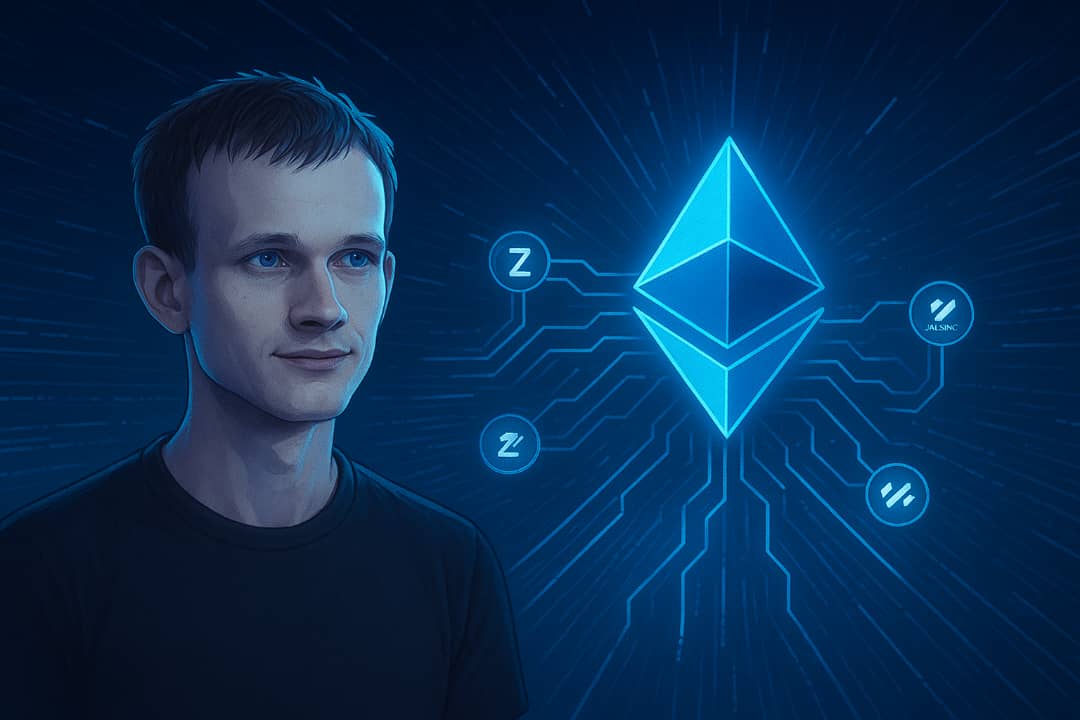
ZKSync just got the biggest nod in crypto, from Vitalik himself. Ethereum’s founder retweeted ZKSync co-founder Alex Gluchowski, calling the project’s work “underrated but valuable.” That single shoutout sent waves through the community, and $ZK holders noticed.
Within hours, ZKSync’s native token began climbing, reflecting renewed optimism around one of Ethereum’s most ambitious Layer 2 (L2) projects. But the timing wasn’t random. The buzz followed ZKSync’s latest network transformation, the Atlas upgrade, now live on mainnet.
https://twitter.com/VitalikButerin/status/1984523871803056592?t=3sU0VTag86PvBKUhfu7AQQ&s=19
The Atlas Upgrade: Ethereum’s L2 Evolution
ZKSync’s Atlas isn’t just another scaling update. It’s a rearchitecture of how liquidity and finality work across Ethereum and its L2 ecosystem.
The upgrade delivers over 15,000 transactions per second (TPS), sub-second finality, and near-zero fees. But beyond raw speed, it introduces real-time L1–L2 liquidity interoperability.
That means ZKSync-based chains can now access Ethereum’s liquidity directly, no need for separate bridge pools or isolated hubs. Liquidity can flow seamlessly, as if the entire Ethereum ecosystem shares one capital base.
In simple terms: Atlas turns Ethereum into an institutional-grade settlement layer, where capital moves frictionlessly across chains and assets.
From Bottlenecks to Breakthroughs
For most users, the biggest pain points on Ethereum have always been speed and costs. Even with multiple L2s, bridging delays and fragmented liquidity remain major bottlenecks. Atlas aims to eliminate both.
Bridge waits fade away as wallets handle L1 to L2 and L2 to L2 transfers automatically. Transactions finalize almost instantly. Slippage drops. Market depth increases.
It’s the kind of UX shift that makes decentralization invisible, everything “just works.”
Builders benefit too. Instead of depending on one-size-fits-all liquidity hubs, projects can now launch specialized app chains that add unique value, in DeFi, payments, gaming, or real-world assets (RWAs).
By syncing directly with Ethereum’s finality, Atlas ensures compliance-ready infrastructure for institutional capital without compromising decentralization.
RWA Meets ZK
The impact of Atlas goes beyond efficiency. ZKSync’s roadmap hints at a clear ambition: to become the liquidity foundation for tokenized real-world assets.
RWAs demand predictable settlement, compliance compatibility, and capital efficiency, all of which Atlas now enhances. By letting Layer 2s operate as extensions of Ethereum’s own liquidity, ZKSync positions itself as a key player in institutional DeFi.
The effect is already visible. ZKSync RWA, a pilot ecosystem integrating real-world asset flows, demonstrates how capital can move between L1 and L2 with real-time assurance.
Ethereum’s Layer 2 Race
ZKSync’s Atlas arrives in a crowded field. Competitors like Arbitrum, Optimism, and Base have grown rapidly by focusing on app ecosystems and developer incentives.
But where most L2s still rely on liquidity hubs or external bridges, ZKSync now enables direct capital interoperability.
It’s a quiet but major shift, from parallel chains to interconnected liquidity layers.
Atlas isn’t trying to replace Ethereum. It extends it. Every new app chain built under this model strengthens Ethereum’s capital base instead of fragmenting it.
As Vitalik noted, “underrated but valuable” might be the most fitting summary yet.
The Institutional Angle
For financial institutions exploring blockchain rails, the biggest concerns are security, compliance, and settlement assurance. Atlas brings Ethereum closer to meeting those standards.
With sub-second ZK finality and shared liquidity, financial-grade apps can now operate on public infrastructure without sacrificing performance or predictability.
It’s a technical achievement, but it’s also a message: Ethereum can scale, responsibly and institutionally.
https://twitter.com/den0thic/status/1984211896040382957?t=3sU0VTag86PvBKUhfu7AQQ&s=19
The Market Response
Following Vitalik’s endorsement and the Atlas rollout, $ZK, ZKSync’s native token, saw a sharp uptick in trading volume.
According to CoinMarketCap, ZK trades at around $0.045, with a market capitalization nearing $370 million as of today. Volume surged over 30% in 24 hours.
While part of the move stems from speculation, analysts see deeper significance. The Atlas upgrade addresses real bottlenecks, creating new utility that could sustain long-term network value.
If adoption grows, $ZK could become more than a governance token, it might underpin one of Ethereum’s most efficient capital layers.
Why Vitalik’s Endorsement Matters
Vitalik rarely singles out projects. His public validation carries weight, especially for technologies aligned with Ethereum’s long-term vision.
By recognizing ZKSync, he’s highlighting the broader ZK-rollup movement, a scaling path that emphasizes cryptographic proofs, not optimistic assumptions.
It’s a vote of confidence in ZKSync’s architectural direction and its role in Ethereum’s evolution.
Risks and Challenges Ahead
Atlas sets a high bar, but challenges remain. Layer 1 gas volatility could affect finality during congestion peaks. There’s also pressure on decentralizing core infrastructure and maintaining validator diversity.
Still, the framework is solid. As Atlas matures, future updates will likely tackle governance, security proofs, and interoperability standards even further.
The Atlas upgrade marks a defining step for ZKSync, and by extension, for Ethereum. It bridges not just capital, but philosophy: scaling without isolation.
Vitalik’s recognition wasn’t just flattery. It was acknowledgment of real, hard engineering progress.
ZKSync is no longer just a Layer 2, it’s becoming Ethereum’s execution layer, a fast, connected fabric where liquidity, compliance, and performance converge.
And if Atlas delivers as promised, the “underrated” label might soon expire.
Disclosure: This is not trading or investment advice. Always do your research before buying any cryptocurrency or investing in any services.
Follow us on Twitter @themerklehash to stay updated with the latest Crypto, NFT, AI, Cybersecurity, and Metaverse news!
