I've covered enough crypto cycles to know that most "record highs" in this industry are about price. This one isn't.
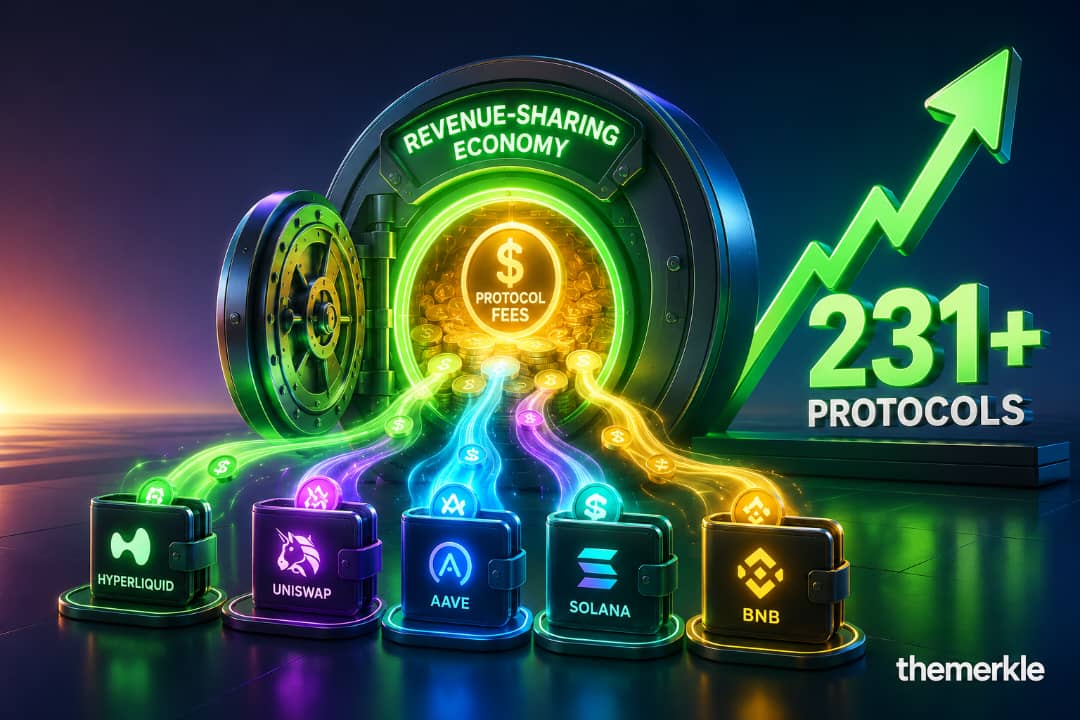
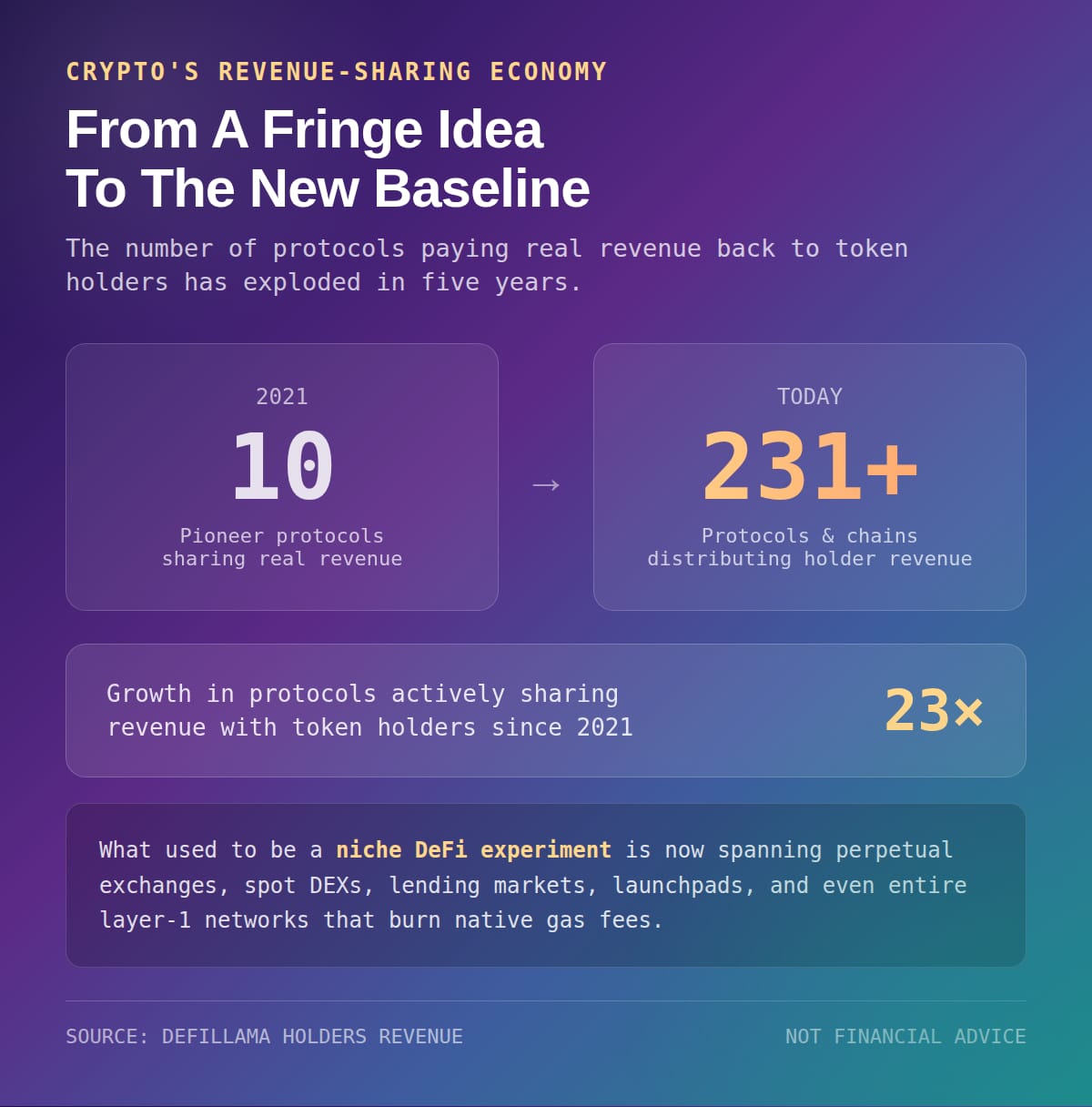
Somewhere in the noise of the last five years, crypto quietly built something that looks a lot like Wall Street: a growing class of tokens that actually pay their holders. Five years ago, you could count the protocols doing this on two hands. Today, more than 231 of them do it, and the number keeps climbing.
That's not a speculative narrative. It's a structural shift in how crypto projects treat the people who hold their tokens, and it's happening largely under the radar while headlines chase the next memecoin or ETF flow.
A market quietly becoming a dividend machine
For most of crypto's history, holding a token got you governance rights and not much else. Fees flowed into treasuries, teams, or liquidity providers, while the token itself was often just a speculative bet on future adoption. That gap between "protocol makes money" and "token holder sees any of it" was the industry's biggest unresolved problem for years.
That gap is closing fast. On-chain trackers such as DeFiLlama's Holders Revenue dashboard now track dozens of protocols and even entire blockchains that route a share of their earnings back to token holders through buybacks, burns, or direct staking payouts. Where this used to be a niche feature reserved for a handful of DeFi experiments, it's now a standard design choice that new projects build in from day one.
The ten pioneers that started it in 2021
Five years ago, the list of protocols sharing real revenue with token holders was short and mostly experimental. The core group that set the template included Binance, whose BNB token had already been subject to periodic burns funded by exchange profits; Ethereum, which introduced its base-fee burn mechanism through the EIP-1559 upgrade in August 2021; and MakerDAO, which used stability-fee income to fund MKR buybacks that same year.
Alongside them sat a handful of DeFi-native names: SushiSwap, which routed a slice of trading fees to xSUSHI stakers; Synthetix, which paid exchange fee rewards to SNX stakers; Curve Finance, whose veCRV model funneled trading fees to long-term lockers; and KyberDAO, which shared network fees with KNC stakers under its Katalyst upgrade. Rounding out the group were 0x, which launched ZRX staking rewards funded by protocol fees; Bancor, which shared trading fees with liquidity providers and stakers; and PancakeSwap, an early adopter of the buyback-and-burn model on BNB Chain.
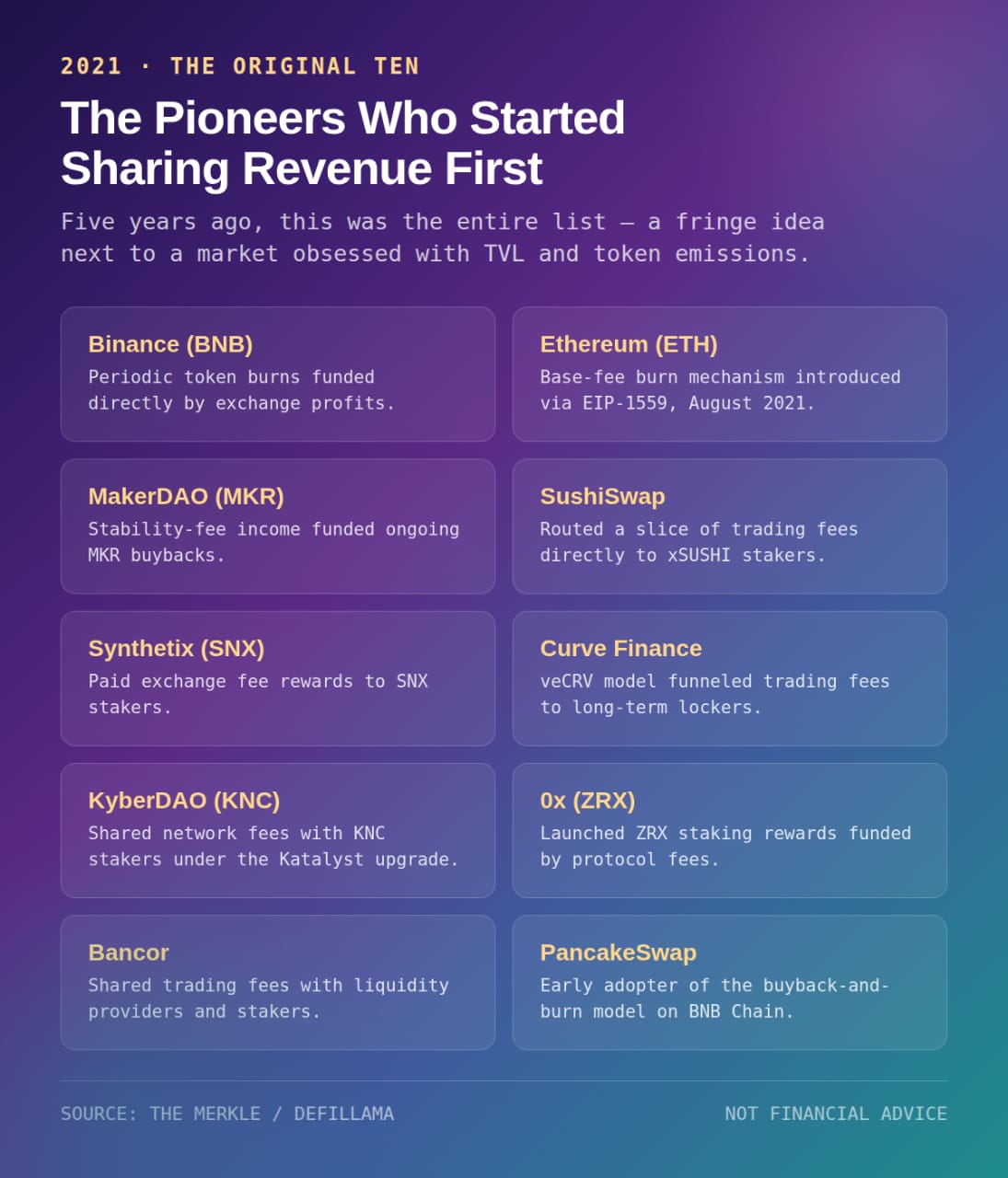
Ten protocols, give or take, depending on how strictly "revenue sharing" was defined at the time. It was a fringe idea sitting next to a market obsessed with total value locked and token emissions.
Two hundred and thirty-one protocols and counting
Fast forward to today, and that fringe idea is the new baseline. The count has grown past 231 protocols and chains actively distributing holder revenue, spanning perpetual exchanges, spot DEXs, lending markets, launchpads, and even layer-1 networks that burn native gas fees outright. What used to be a differentiator is turning into table stakes for any token hoping to be taken seriously by investors who read balance sheets before they buy.
Part of that growth comes from imitation. Once a handful of tokens proved that fee-funded buybacks could support price and attract sticky holders, competitors across every DeFi vertical raced to copy the model rather than get left behind.
Hyperliquid, Uniswap and the new leaderboard
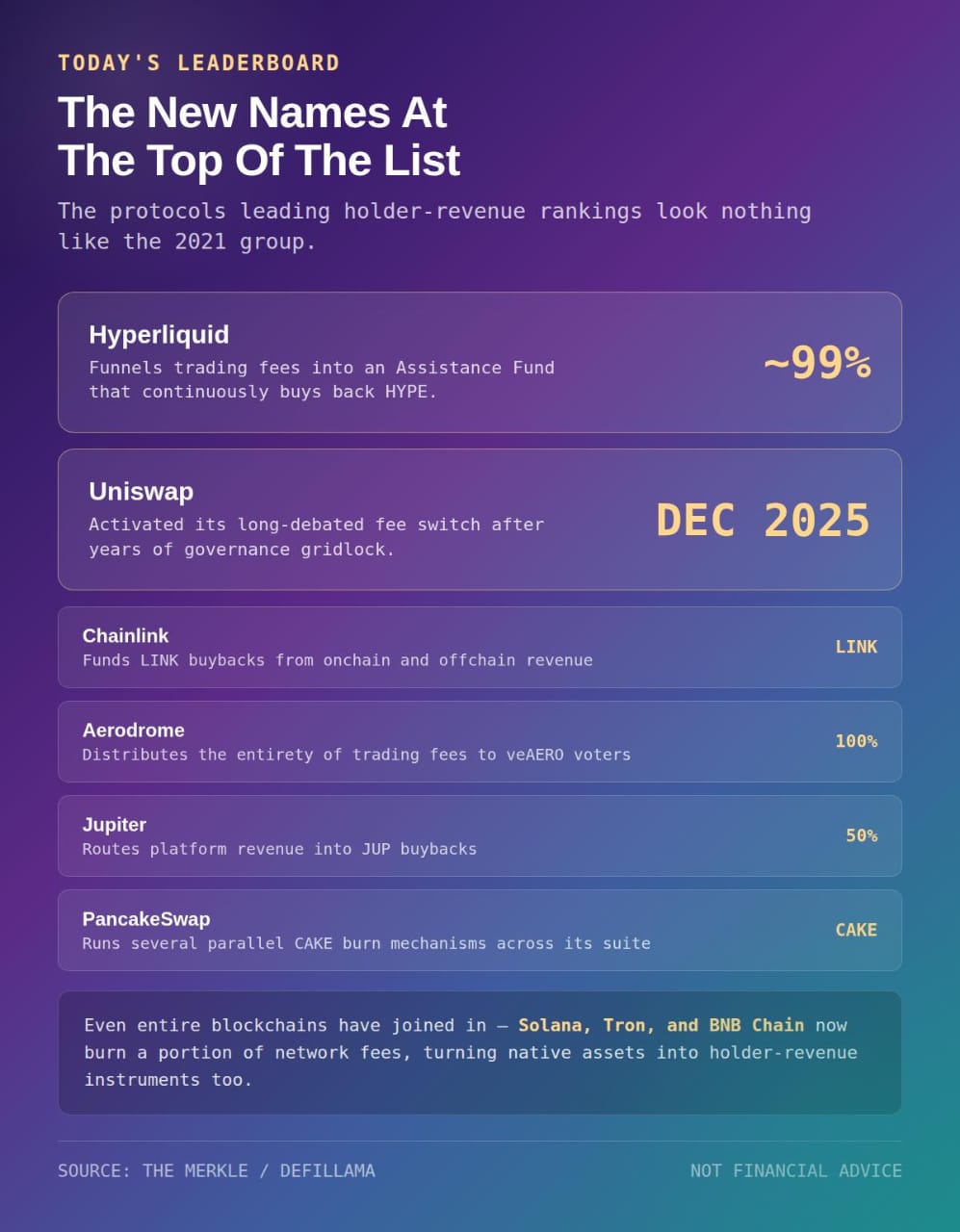
The protocols at the top of today's holder-revenue rankings look nothing like the 2021 list. Hyperliquid currently leads the pack, funneling roughly 99% of its trading fees into an Assistance Fund that continuously buys back HYPE. Uniswap activated its long-debated fee switch in December 2025, finally allowing a share of swap fees to fund UNI buybacks and burns after years of governance gridlock.
Behind them sits a broader field: Chainlink now funds LINK buybacks from onchain and offchain revenue, Aerodrome distributes the entirety of its trading fees to veAERO voters, Jupiter routes half of its platform revenue into JUP buybacks, and PancakeSwap runs several parallel CAKE burn mechanisms across its product suite. Even entire blockchains have joined in, with Solana, Tron, and BNB Chain now burning a portion of network fees, effectively turning their native assets into holder-revenue instruments alongside application-layer tokens.
Why the money is suddenly flowing
Part of the shift is regulatory. A friendlier stance toward digital assets in the United States has made teams less nervous about structures that resemble dividends, easing a fear that lingered for years. Bitwise chief investment officer Matt Hougan captured the mood shift directly, arguing that crypto valuations outside Bitcoin could double or more as protocols increasingly link revenue to token value, pointing to Hyperliquid, Uniswap, Aave, and Pump.fun as early movers.
Even protocols that resisted the trend are coming around. Aave Labs proposed sharing revenue generated outside its core lending protocol with AAVE holders earlier this year, a notable concession from a project that spent years treating its token as governance-only.
What it means for token holders now
I'd caution against reading this as a guarantee that every token with a buyback mechanism deserves a premium valuation. Plenty of the 231-plus protocols distribute modest sums, and research from Castle Labs has pointed out that headline revenue and actual tokenholder cash flow are still two very different numbers worth checking separately before buying the story.
Still, the direction of travel is unmistakable. What started as an experiment among ten protocols in 2021 has become one of the defining trends of this market cycle, and it's reshaping how serious investors evaluate a token in the first place. Fees, distribution mechanics, and dilution are becoming as important to crypto research as APY once was. For an industry regularly accused of manufacturing value out of nothing, that's a meaningfully more grown-up conversation to be having.
Disclosure: This is not trading or investment advice. Always do your research before buying any cryptocurrency or investing in any services.
Follow us on Twitter @themerklehash to stay updated with the latest Crypto, NFT, AI, Cybersecurity, and Metaverse news!