
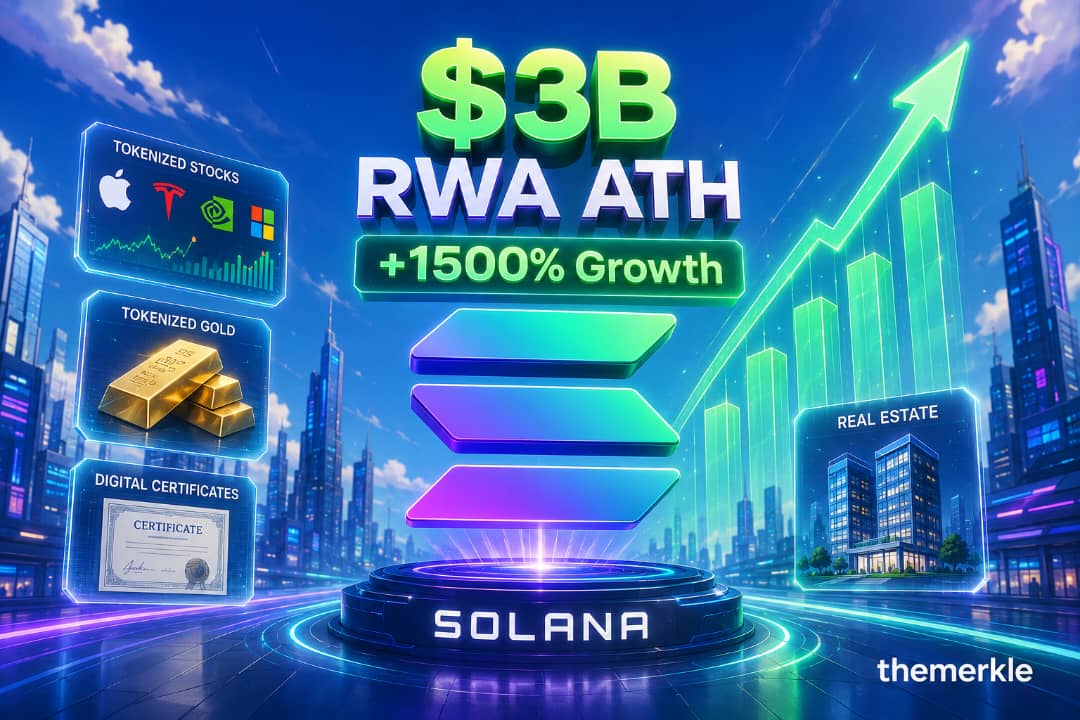
Solana’s real-world asset ecosystem just crossed a threshold that would have seemed impossible not long ago.
Total RWA value on the network has surpassed $3 billion, marking a new all-time high and capping an 18-month run that has seen the ecosystem grow by 1,500% from where it started.
The milestone is not arriving quietly. Solana’s RWA ecosystem now counts BlackRock, Paxos, Maple, and Ethena among its active participants, a roster of institutional names that signals this is no longer a speculative corner of the network but a functioning infrastructure layer attracting serious capital. Daily transfer volume hit a record $1.49 billion on June 10, confirming that the value sitting in the ecosystem is actively moving rather than sitting idle.
The 1,500% growth figure over 18 months is the kind of trajectory that gets institutional attention. When a network’s real-world asset layer goes from a standing start to $3 billion with that kind of velocity, the question stops being whether the infrastructure works and starts being how much larger it can realistically get.
What Is Driving The $3B Milestone
The composition of Solana’s RWA ecosystem is broader than most people tracking it from the outside might expect. Tokenized stocks, tokenized gold, real estate, and other traditional asset classes are all represented, giving the ecosystem a diversification across asset types that makes the $3 billion figure more durable than if it rested on a single category.
Tokenized stocks have been a significant contributor to recent growth, particularly following the SpaceX Nasdaq debut. Assets like $SPCX carry a meaningfully different risk profile than the meme coins that have historically dominated Solana’s trading volume and that difference is starting to attract a different class of participant. Lower volatility risk relative to native crypto assets makes tokenized equities appealing to holders who want on-chain exposure without the price swings that come with speculative tokens.
The institutional names now active on Solana’s RWA layer are the clearest signal of where this is heading. BlackRock, Paxos, Maple, and Ethena are not experimenting with RWAs on a network they do not believe in, their presence reflects a deliberate infrastructure choice based on Solana’s settlement speed, transaction costs, and the depth of the ecosystem around it.
Daily Transfer Volume Hits $1.49B Record
The $1.49 billion daily transfer volume record set on June 10 is the data point that most directly answers the question of whether Solana’s RWA growth is real activity or just locked value sitting in smart contracts. $1.49 billion moving in a single day means the assets are being used, transferred, traded, settled, and deployed, not just held passively as a balance sheet entry.
That level of transfer volume puts Solana’s RWA layer in the company of settlement infrastructure that handles real commercial flows. The combination of 24/7 availability and instant settlement that blockchain infrastructure provides is particularly well-suited to asset classes like tokenized stocks and commodities, where traditional settlement windows create friction and counterparty risk that on-chain settlement eliminates.
The record transfer day landing on June 10, two days before SpaceX’s Nasdaq debut, is also not coincidental. The pre-IPO tokenized stock activity and the rush to get SPCX exposure through on-chain products drove significant transaction volume through Solana’s infrastructure in the days leading up to the listing. That kind of event-driven volume stress test, handled cleanly at $1.49 billion in a single day, reinforces the network’s credibility as a settlement layer for high-velocity asset flows.
Tokenized Stocks Change the Lending Equation
One of the more concrete downstream effects of tokenized stocks arriving on Solana’s RWA layer is showing up in lending protocols. Because assets like $SPCX carry substantially lower volatility risk than meme coins or other native crypto tokens, lenders are able to extend more favorable terms against them as collateral.
Loan terms for RWAs are being increased to up to 30 days as a direct result of the improved risk profile that tokenized stocks bring to collateral arrangements. A 30-day loan term against a tokenized equity is a meaningfully different product from a short-duration loan against a volatile memecoin, it creates a credit facility that institutional borrowers can actually incorporate into treasury management workflows rather than just speculative trading.
This evolution of lending terms around RWA collateral is one of the ways that real-world asset tokenization creates compounding value in a DeFi ecosystem. Better collateral attracts better lending terms. Better lending terms attract more sophisticated borrowers. More sophisticated borrowers bring more capital and more institutional legitimacy to the ecosystem. Each step reinforces the next, which is part of what makes the 1,500% growth over 18 months a foundation rather than a ceiling.
Disclosure: This is not trading or investment advice. Always do your research before buying any cryptocurrency or investing in any services.
Follow us on Twitter @themerklehash to stay updated with the latest Crypto, NFT, AI, Cybersecurity, and Metaverse news!
