
Well, Pyth Network isn’t shying away with their new move and it happens to collect some big names from the traditional finance world.
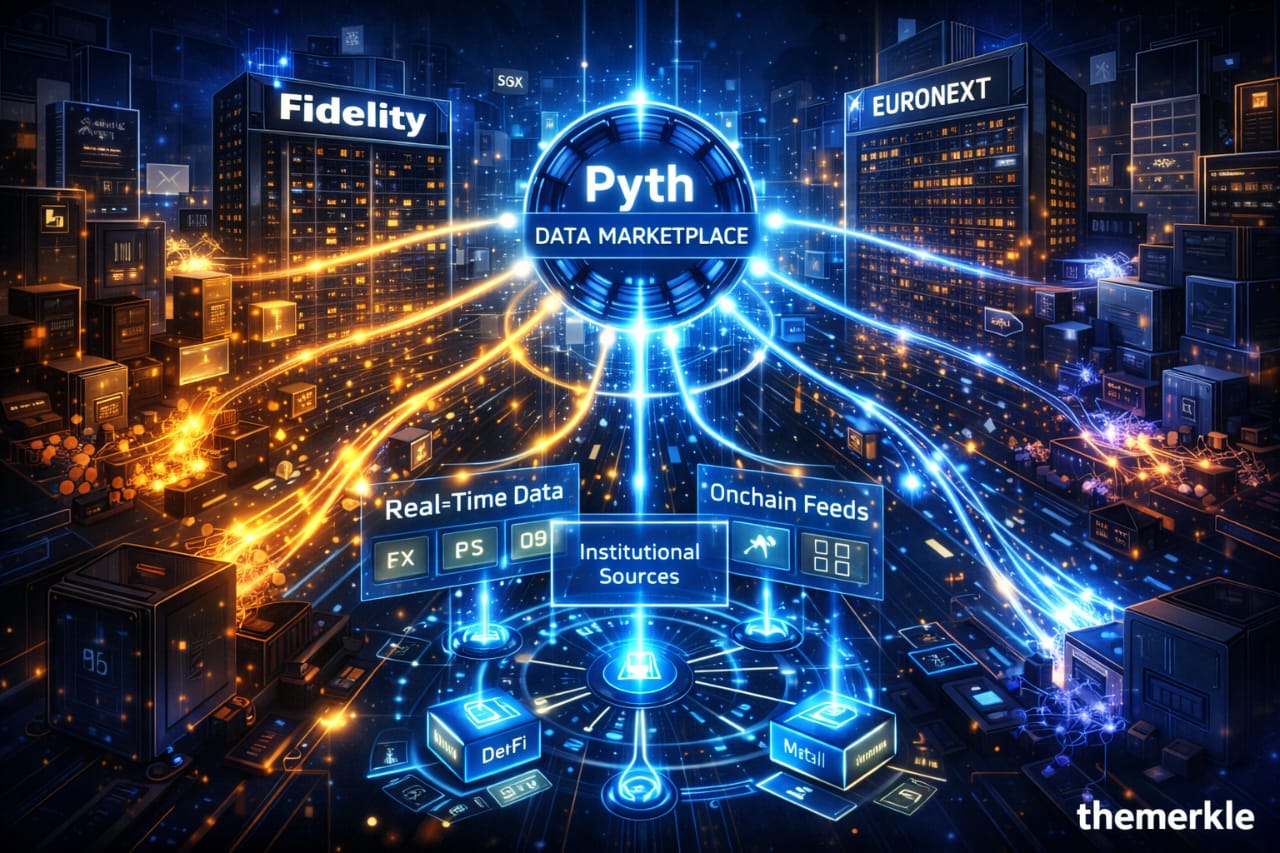
It has officially launched its Data Marketplace bringing six leading financial institutions onchain to deliver real-time market data.
🚨BREAKING: 6 GLOBAL FINANCIAL TITANS JOIN PYTH TO STREAM PROPRIETARY DATA ONCHAIN@PythNetwork has introduced the Data Marketplace. The protocol partners with Fidelity Investments, Euronext, and four other major financial institutions to move proprietary market data directly… pic.twitter.com/3OewiXQ564
— BSCN (@BSCNews) April 9, 2026
At first, it may sound like any typical partnership announcement. But the particulars make it more intriguing, because this isn’t about surface collaboration. They are pressing their proprietary data on top of the blockchain infrastructure.
Heavy Hitters From Traditional Finance Enter the Fray
The list of partners speaks volumes in itself.
Along with Tradeweb, OTC Markets Group, SGX FX and Exchange Data International, Fidelity Investments and Euronext are members of the group.
These aren’t small players.
Fidelity is one of the world’s biggest asset managers, mentioned in the same breath as firms like BlackRock and Vanguard. On the other hand, Euronext operates several of Europe’s largest stock exchanges.
So you’re already looking at companies that sit near the center of global finance.
And now they’re supplying data to a crypto-native system.
What The Data Marketplace Really Is
The Pyth Data Marketplace is essentially a framework that allows such institutions to publish their market data directly onchain.
We’re referring to real-time pricing for fixed income, crude swaps, spot FX and precious metals.
Typically, this type of data lies behind closed systems, terminals, subscription platforms and so on.
Access is typically scarce and expensive.
Attestations and other data about the user is directly in a safe on-chain (to prevent gaze of prying eyes), which Pyth is attempting to transfer into a more open environment; allowing for utilization by decentralized applications.
It’s not so much generating new data as redistributing existing data differently.
Timesaving By Reducing The Middle Layers
This very setup relies on one of its major concepts, eliminating intermediaries.
Rather than having data pass through multiple layers before it reaches the end users, it’s published directly by the source on to the network.
That allows developers and platforms to access it more directly.
In addition, the system gives full control of pricing and attribution, something important for the institutions supplying the data.
They’re not just giving it up, they still own and control what goes out, how it’s distributed.”
Why This Matters For DeFi
Access to reliable data has long been an issue for decentralized finance.
Many DeFi applications from lending to derivatives to trading systems rely on price feeds for their functionality.
If the data isn’t accurate (or timely), things can break down pretty fast.”
Between Fidelity Investments and Euronext, Pyth is effectively raising the bar on its data input.
Instead of focusing largely on crypto-native feeds, it’s now drawing from some of the largest players in traditional finance.
In theory, that might make reliability better.
From Closed Systems to Open Infrastructure
Historically, financial data remained a well-guarded secret.
If you want access, and regardless of whether you’re a Scrabble aficionado or casual player, who wouldn’t?, you typically pay for it, sometimes dearly.
What’s going on here feels like a break with that model, or at least an expansion beyond it.
In doing so this data becomes available onchain and in ways never before possible.
It provides developers a means to integrate into applications bypassing the traditional gatekeepers.
It doesn’t mean everything immediately becomes free or open, but the data flow itself is changed.”
No Longer Just A Crypto Experiment
Moves like this make it more difficult to claim that blockchain is still experimental in the area of finance.
When firms such as Fidelity Investments are involved, that means business.
These are companies that typically don’t leap without a reason.
So their involvement is evidence this has real value,” said Stoller.
It also illustrates that the divide between traditional finance and crypto isn’t as great as it was before.
Pyth’s Position Begins To Change
This launch is making Pyth Network look a little more distinguished.
There are plenty of oracle and data protocols coming out of crypto that have proven themselves to accept institutional participation at this level.
Pyth is creating a closer connection to the source of truth for financial information by directly connecting with major data providers.
That is a good position to be in, particularly if adoption continues to grow.
Just Seems Back To One Of Those Quiet But Significant Moments
This isn’t a news story that rewrites everything overnight.
But in my gut, it feels like one of those moments that might matter more later.
Companies in traditional finance are increasingly plugging into blockchain systems directly, rather than just watching from the sidelines.
That’s a new level of engagement.
And if this trend repeats itself at other institutions, the manner in which financial data is distributed, and used, could begin to look quite different.
For now, it’s still early.
With players like Fidelity Investments and Euronext already involved, it’s clear this is no longer a small experiment.
Disclosure: This is not trading or investment advice. Always do your research before buying any cryptocurrency or investing in any services.
Follow us on Twitter @themerklehash to stay updated with the latest Crypto, NFT, AI, Cybersecurity, and Metaverse news!
