
Kimi K3, a massive 2.8-trillion-parameter open-weight model from Moonshot AI, breaks the pattern of unsubstantiated hype by delivering genuine, frontier-level reasoning.
Backed by impressive third-party benchmark data, this release marks the first time a Chinese model is actively forcing the industry to re-evaluate where the global AI frontier actually sits.
Moonshot AI unveiled Kimi K3 yesterday, claiming performance close to Anthropic's Claude Fable 5 and OpenAI's GPT-5.6. The model runs on a Mixture-of-Experts architecture with 2.8 trillion total parameters, making it the largest open-weight model released to date, and it ships with a 1 million-token context window capable of digesting entire codebases, books, or research papers in a single prompt. Here's where I think it genuinely closes the gap, and where it still falls short.
Kimi K3 Takes The Frontend Coding Crown
The result that stopped me in my tracks is Kimi K3 landing at number one on the Frontend Code Arena with 1679 points, a 17-place jump from Kimi K2.6, which sat at 18th.
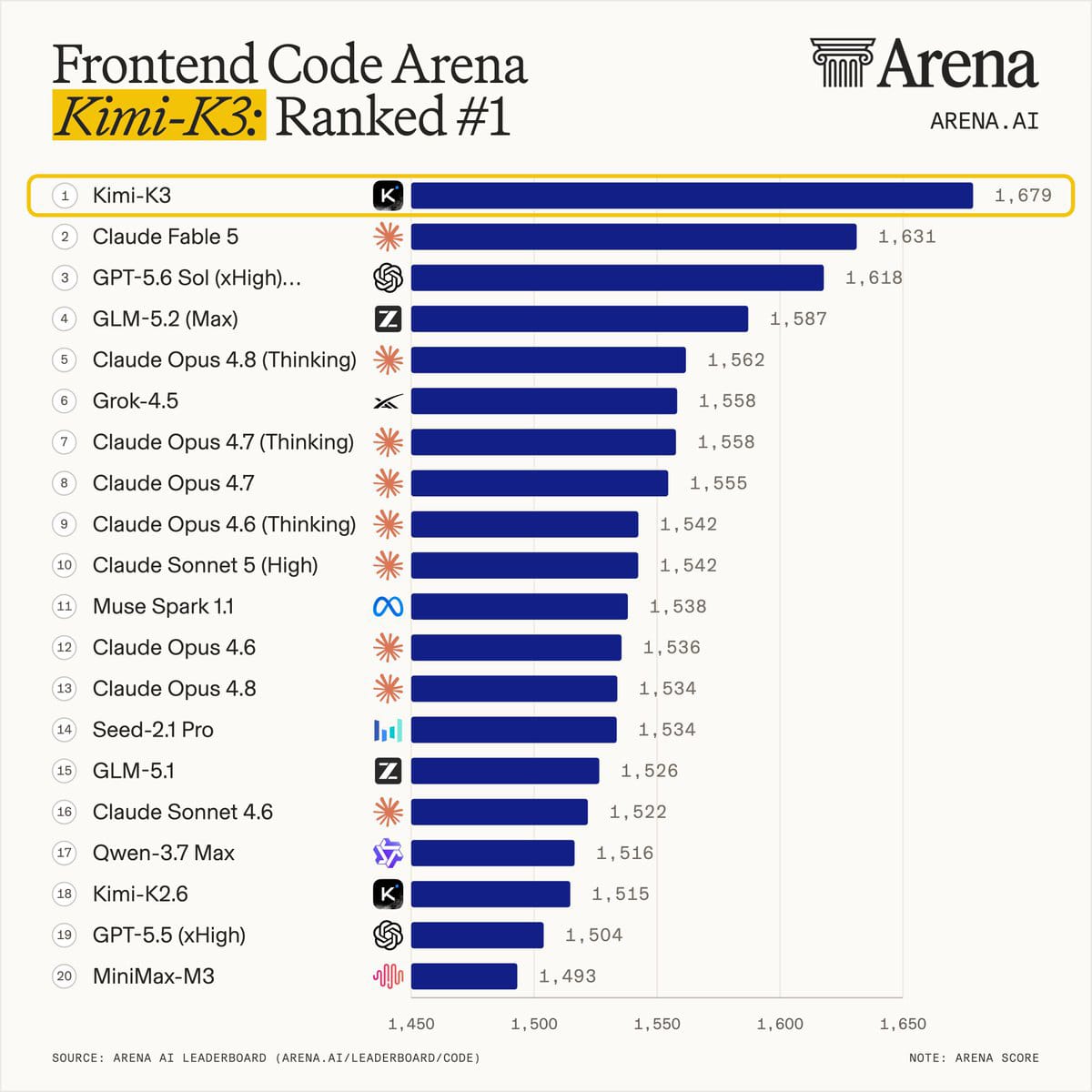
It didn't just edge past the competition either. Kimi K3 ranked first in six of seven frontend domains, covering brand and marketing, reference-based design, data and analytics, consumer products, simulations, and content creation tools, landing second only in gaming, behind Fable 5.
I think this is the single most important data point in the entire release. Frontend code generation has become one of the clearest proxies for real-world usefulness, and beating every major lab except one narrow category is not a marginal result.
Agentic Performance Closes The Gap With Fable 5
On agentic benchmarks, Kimi K3 posted an Elo rating of 1668 on GDPval v2, a sharp jump from K2.6's 1190 and enough to surpass GLM-5.2 at 1514, GPT-5.5 at 1494, and Claude Opus 4.8 at 1600. It still trails Fable 5's 1760, but the gap has narrowed considerably. On AA-Briefcase, a private evaluation of long-horizon agentic knowledge work, K3 scored an overall Elo of 1547, up 732 points over K2.6, placing second behind only Fable 5.
Its rubric scoring and analytical quality come close to matching Fable 5's numbers, though GPT-5.6 Sol still leads on presentation quality specifically. K3 isn't beating Fable 5 outright on agentic work, but it's close enough that the distance no longer feels like a different tier.
Pricing Undercuts Opus, Stays Competitive With GPT-5.6 Sol
Cost is where I think Kimi K3 makes its strongest commercial case. At $0.94 per task, it lands close to GPT-5.6 Sol's $1.04 and roughly half the price of Opus 4.8's $1.80, a meaningful advantage for anyone running high-volume agentic workloads. Worth noting, though: Moonshot raised its own pricing significantly compared to K2.6, with output tokens jumping to $15 per million from $4 previously. First-party API pricing sits at $3.00 input and $15.00 output per million tokens, with a 90% discount on cached input bringing that down to $0.30. So while K3 undercuts the biggest US labs, it's noticeably pricier than open-weight peers like GLM-5.2 at $0.32 per task and DeepSeek V4 Pro at $0.04. Kimi K3 competes with frontier-tier pricing, not budget open-weight pricing, even before its own weights are public.
Efficiency Gains And What's Still Coming
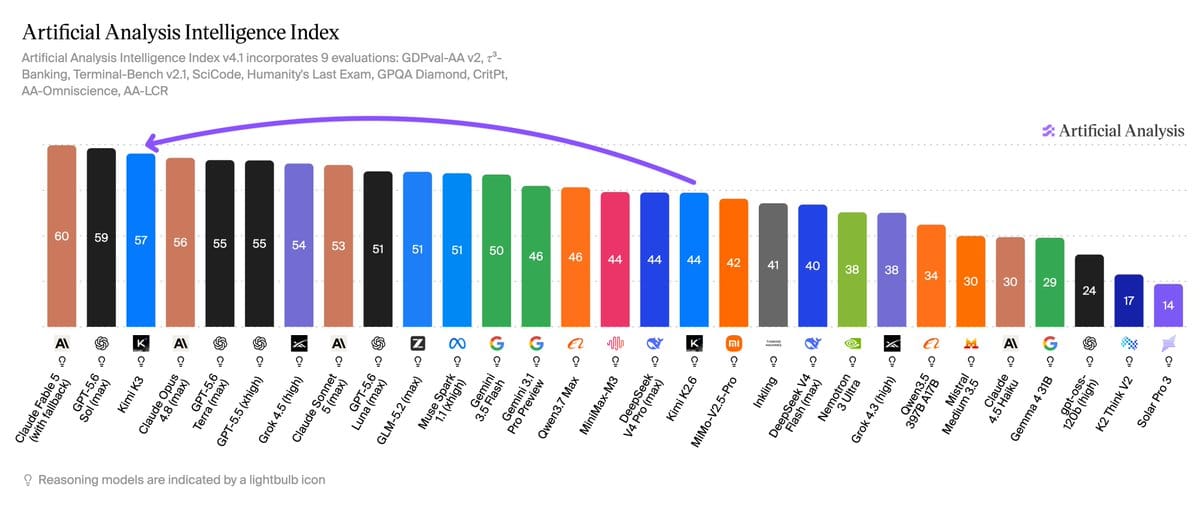
One detail I think got underplayed in the initial coverage is token efficiency. Kimi K3 used roughly 132 million output tokens to complete all nine evaluations on the Artificial Analysis Intelligence Index, down from about 166 million for K2.6, a 21% reduction, while scoring higher across the board. The model also ships with native multimodal input for text and images, though output remains text-only for now. Moonshot has confirmed plans to release the full 2.8 trillion parameter weights by July 27, which would make Kimi K3 the leading open-weight model by a wide margin over GLM-5.2's 753 billion parameters and DeepSeek V4 Pro's 1.6 trillion.
Chinese AI Stocks Tell A Different Story
Not everyone in the region benefited. Zhipu crashed 28% and MiniMax fell 16% in the aftermath. I think that reaction says something important on its own: the market is treating Kimi K3 as a genuine competitive threat to other Chinese labs, not just a marketing exercise.
When a model launch wipes out nearly a third of a competitor's valuation in a single day, that's not noise.
What This Means For The US AI Race
For the first time, a Chinese model has taken the top spot on the Frontend Code Arena and is scoring at or near the frontier on several benchmarks at once. That's a real inflection point, not a one-off result. The framing making the rounds argues that while Moonshot ships frontier-competitive models on tight timelines, American policymakers are busy banning data centers and stacking regulations. It's a fair point, though not a settled one, plenty would argue guardrails exist because the stakes of getting safety wrong at this scale are asymmetric in a way the early internet never was. Kimi K3's results are real either way. Whether the right response is fewer rules or smarter ones is the argument actually playing out, and this launch doesn't settle it.
Disclosure: This is not trading or investment advice. Always do your research before buying any cryptocurrency or investing in any services.
Follow us on Twitter @themerklehash to stay updated with the latest Crypto, NFT, AI, Cybersecurity, and Metaverse news!