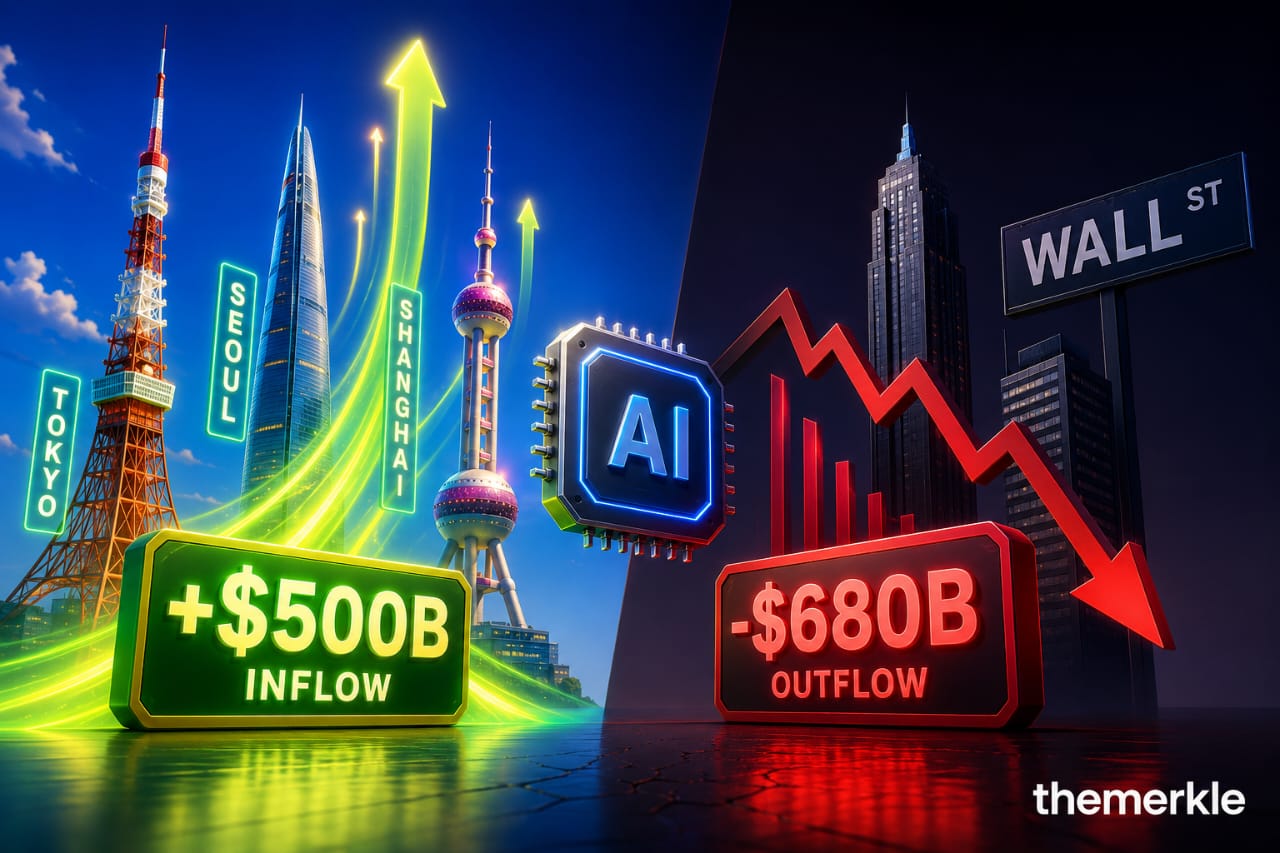
As markets in Asia soared while Wall Street's AI trade took a steep plunge, two of the world's biggest markets moved in almost opposite directions today and if you only looked at one of them, you'd walk away with completely the wrong read on how investors are actually feeling right now.
On one side of the Pacific, more than half a trillion dollars just poured into South Korean, Japanese, and Chinese equities in a matter of hours.
On the other, Wall Street watched $680 billion evaporate in about 120 minutes, with the AI trade's poster child taking the hardest hit of all. I think this split is the real story here, not either half of it on its own and it's the angle I want to walk through carefully rather than just report the headline numbers.
A Trillion-Dollar Tale of Two Markets
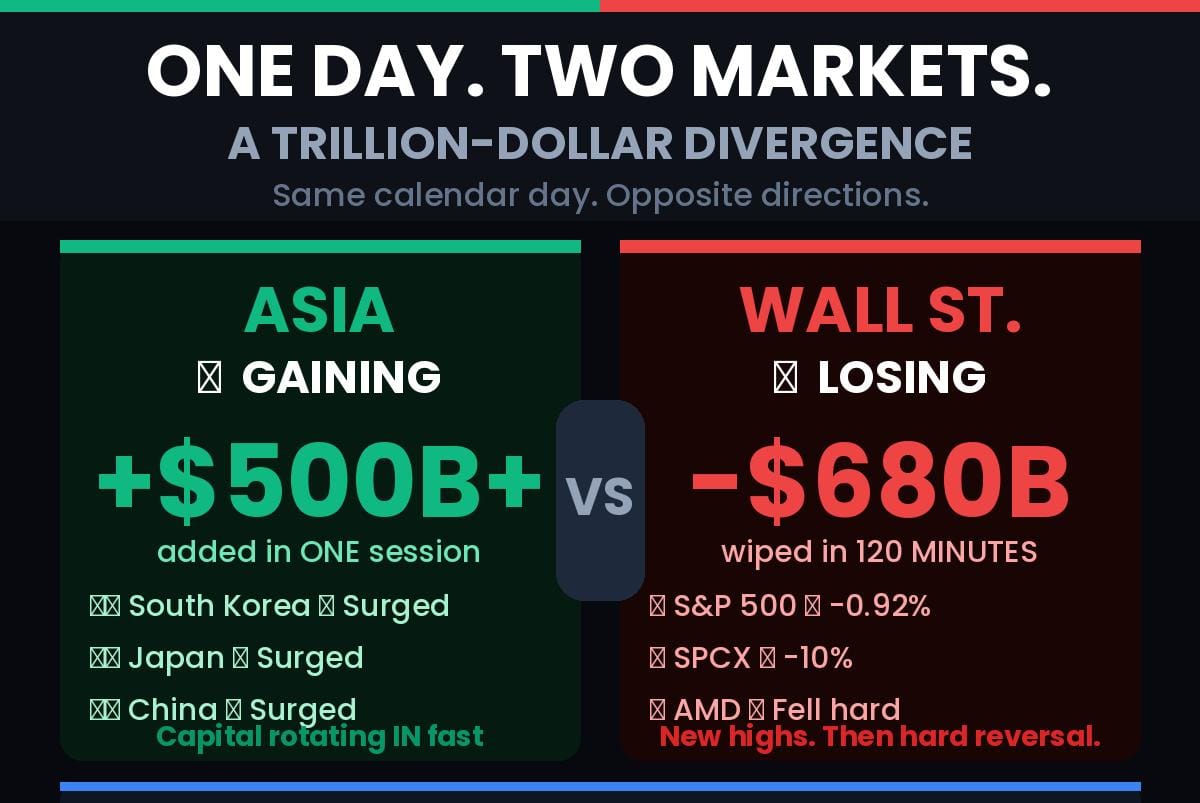
Let's start with the number that's hard to ignore: over $500 billion was added to South Korean, Japanese, and Chinese stock markets today, according to data that's been getting a lot of attention this morning. That's not a typo, and it's not a slow-drip rally either, this is money moving fast, in a single session, across three of Asia's largest exchanges at once.
What makes this genuinely interesting to me is the timing. This surge landed on the same calendar day that Wall Street gave back a chunk of its own recent gains, and I don't think that's a coincidence. To me, it reads like capital rotating in real time rather than a simple "everything is up" story, and that distinction matters more than most headlines are giving it credit for.
Why Asian Stocks Are Pumping
There are three forces feeding this, and honestly, they all reinforce each other rather nicely. First, the S&P 500 and Dow Jones both closed at fresh all-time highs, and when Wall Street sets new records, that optimism tends to ripple outward into Asian trading hours almost immediately. Second, and I'd argue this is the bigger driver by far, the US and Iran appear to be closing in on an interim agreement to reopen the Strait of Hormuz, a waterway that a fifth of the world's oil physically passes through, and one whose closure has been hanging over energy markets for months. Third, crude oil crashed below $76, which does two things at once in my view: it takes inflation pressure off the table, and it frees up risk appetite for exactly the kind of growth and tech names that had been getting punished while oil stayed elevated.
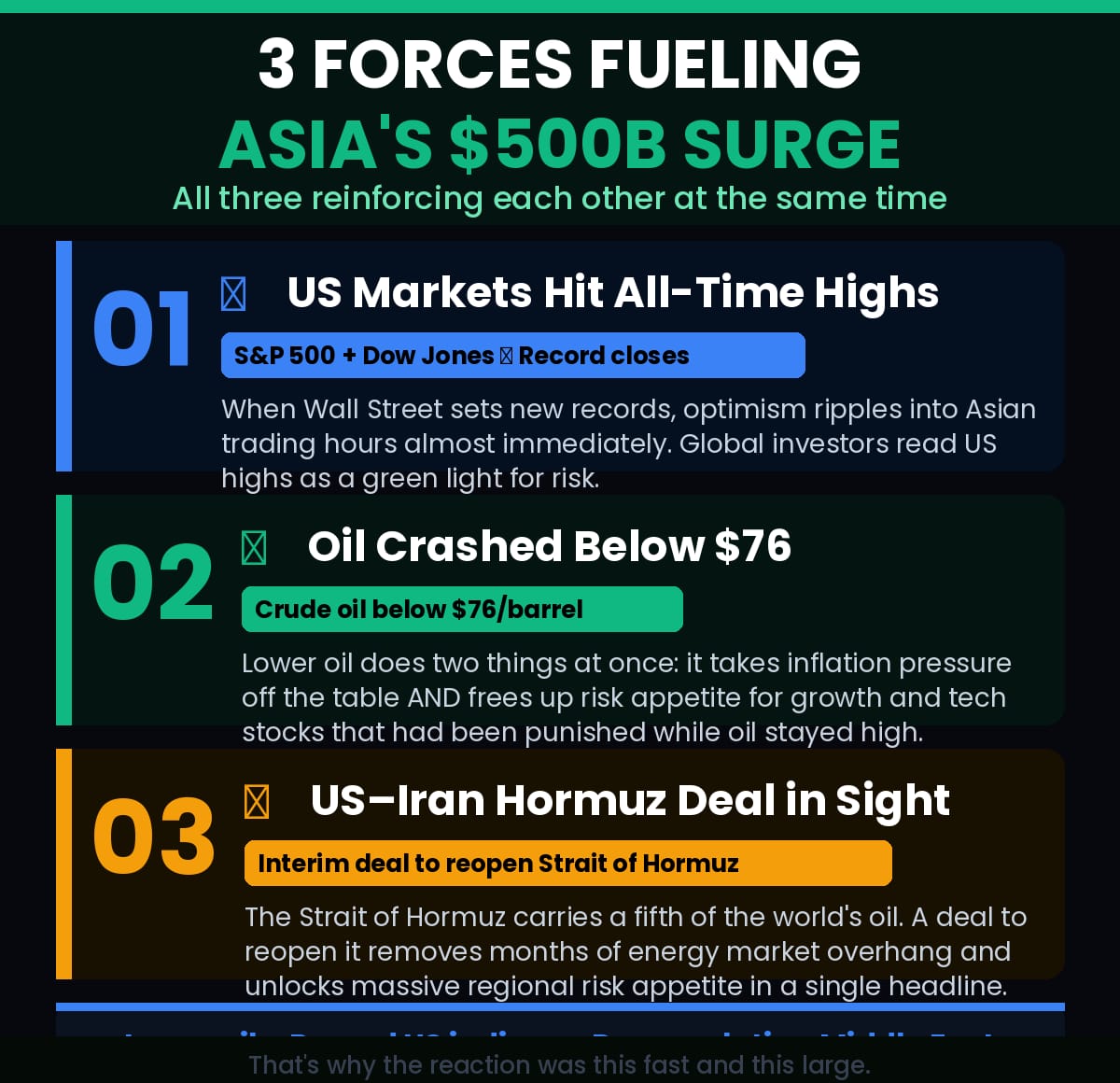
Put those three together and you get a genuinely coherent bull case for Asian equities, one I find hard to argue with on the fundamentals alone. Lower oil, record US indices, and a de-escalating Middle East story is about as clean a green-light signal as macro traders get, and I think that's exactly why the reaction was this fast and this large.
Wall Street's Mood Swings Hard in Two Hours
Here's where the story flips, though, and I think this is the part people are sleeping on. Just hours after those records, $680 billion was wiped off the US stock market in a two-hour window as the S&P 500 dropped 0.92%. That's a violent reversal for an index that had just been celebrating new highs, and it's a good reminder, one I try to keep in mind whenever I'm writing about "record closes", that a new high and steady conviction are not the same thing.
What strikes me most, going through it myself, is how concentrated the damage actually was. This wasn't a broad market puke. It was a couple of very specific, very large stories doing nearly all of the work.
SpaceX's Lockup Problem Nobody Saw Coming
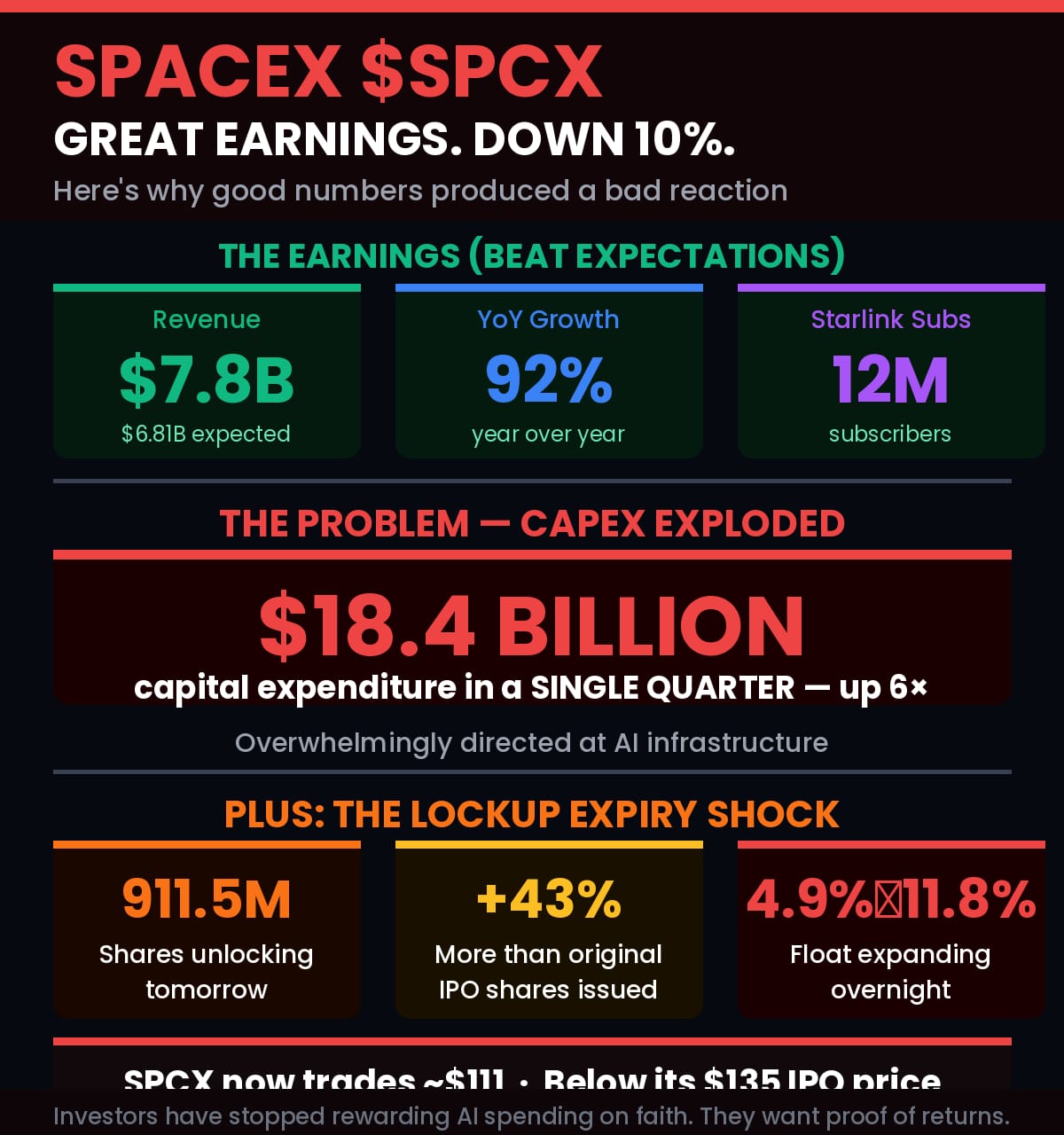
The biggest single name in that reversal was SpaceX, and I'll admit this is the part of the story I find most fascinating. A total of 911.5 million shares of $SPCX, held by employees and early investors, become eligible to trade tomorrow, that's roughly 43% more than the 638.9 million shares originally issued at IPO, and it pushes SpaceX's free float from just 4.9% up to 11.8% of outstanding shares. That's an enormous supply shock landing on a stock that's already been under pressure, and honestly, I think it's the kind of structural detail that gets buried under earnings headlines even though it matters more than most of them.
And the earnings themselves genuinely weren't bad, which is what makes today's reaction so telling to me. Revenue came in at $7.8 billion against $6.81 billion expected, up 92% year over year, with Starlink now sitting at 12 million subscribers. By almost any normal standard I'd apply, that's a strong quarter. Yet SPCX is down 10% today anyway, and that gap between "good numbers" and "bad reaction" is exactly the kind of disconnect I think is worth sitting with rather than glossing over.
The AI Spending Bill Comes Due
The real issue, as I read it, was capex. Spending jumped sixfold to $18.4 billion in a single quarter, overwhelmingly directed at AI infrastructure. I think this is the crux of the whole story: investors have shifted from rewarding companies simply for saying "we're investing in AI" to demanding actual proof that the spending converts into profit. That's a meaningfully higher bar than the one AI-adjacent names have been clearing for the past couple of years, and I don't think it's a bar that's going to lower again anytime soon.
Elon Musk's response was to double down rather than pull back, moving his target forward and saying SpaceX now hits $1 trillion in annual revenue by 2030 instead of 2031. I understand the confidence, but the stock, for what it's worth, now trades around $111, below its $135 IPO price and the lockup expiring tomorrow only adds to the overhang, since up to 20% of shares could hit the market at once. To me, that timing couldn't be worse for anyone hoping sentiment turns quickly.
$AMD told a strikingly similar story today, and I don't think that's a coincidence either. It's exactly the same underlying reason: the market has stopped paying for AI spending on faith alone.
What This Divergence Really Tells Us
Reading across today's action, I don't think the takeaway is "Asia good, America bad," or the reverse, that's too simple, and I'd push back on anyone framing it that way. What I actually see is a market getting more selective in real time. Macro tailwinds like falling oil and a potential Iran deal are lifting entire regions and broad indices at once, while individual AI-spending stories are being judged company by company, quarter by quarter, on whether the capex actually shows up as revenue rather than just ambition. Asia caught the tailwind today. SpaceX and AMD, despite genuinely strong headline numbers, got caught in the part of the market that's asking harder questions. That's the split I'll be watching for the rest of this week, not just the index moves on either side of the Pacific.
Disclosure: This is not trading or investment advice. Always do your research before buying any cryptocurrency or investing in any services.
Follow us on Twitter @themerklehash to stay updated with the latest Crypto, NFT, AI, Cybersecurity, and Metaverse news!