

Most executives, including Michael Saylor, typically credit spreadsheets, bankers, or a lucky market window when raising billions, except this time, Saylor is crediting a chatbot.
In a conversation that's since rippled across finance and crypto circles alike, the Strategy founder claimed he used artificial intelligence to design a financing structure that, according to his own account, generated roughly $15 billion for his Bitcoin-holding company, something he says traditional bankers and lawyers told him couldn't be done at all.
The Claim That Stopped The Interview
Saylor made the comment during an August 6 appearance on The Diary Of A CEO, hosted by Steven Bartlett. According to a full transcript of the episode, Saylor told Bartlett plainly: "I used an AI to make $15 billion in a way that no one would ever conceive that you could make $15 billion."
Bartlett, visibly taken aback, pressed him on whether the story was actually true, to which Saylor confirmed it was. You can listen to the full episode directly through the show's official platform here: The Diary Of A CEO — iHeart
What struck me most reading through the exchange isn't just the dollar figure, it's how specific Saylor got about the AI tool itself. When Bartlett asked which system he'd used, Saylor answered directly: ChatGPT, built by OpenAI. That's a notably concrete attribution for a claim this large, and it's part of what's made the story spread as fast as it has.
Why Strategy Needed A New Kind Of Financing
To understand why this claim matters, you need the backstory Saylor laid out himself. By early 2025, Strategy was sitting on roughly $30 billion worth of Bitcoin, built primarily through years of issuing convertible bonds. But that approach was reaching its practical ceiling. Lawyers, bankers, and conventional investors, in Saylor's telling, had never seen anything like what he was proposing next and weren't confident it could be pulled off within existing securities frameworks.
Rather than scale back, Saylor said the team turned directly to AI to explore financing structures nobody in the room had encountered before. That process eventually produced STRK, formally Strategy's 8.00% Series A Perpetual Strike Preferred Stock, a convertible preferred security designed to sit between traditional debt and common equity while giving Strategy a fresh lever to keep buying Bitcoin. The company's own announcement of the STRK program's $21 billion at-the-market offering capacity is available directly through its SEC filing here: Strategy Announces $21 Billion STRK At-The-Market Program — SEC.gov.
Inside STRK: The Instrument AI Reportedly Helped Design
STRK isn't a simple bond or a plain equity raise, and understanding its structure explains why Saylor frames it as a genuine innovation rather than a routine capital markets exercise. Each STRK share carries an 8% cumulative dividend and is convertible into Strategy's Class A common stock at a fixed ratio, giving investors both a steady income stream and optionality tied to Bitcoin-driven upside in the stock. It launched in early January 2025 as an initial offering before scaling into the much larger at-the-market program.
I think what made this genuinely novel, at least based on how Saylor described the process, wasn't any single feature of STRK in isolation, it was combining a perpetual, convertible, cumulative-dividend structure specifically engineered to keep flowing capital toward Bitcoin purchases without the refinancing pressure that comes with traditional debt. According to Saylor, that combination is what AI helped the team land on after human advisors had effectively stalled.
From $2.5 Billion To $15 Billion: Breaking Down The Numbers
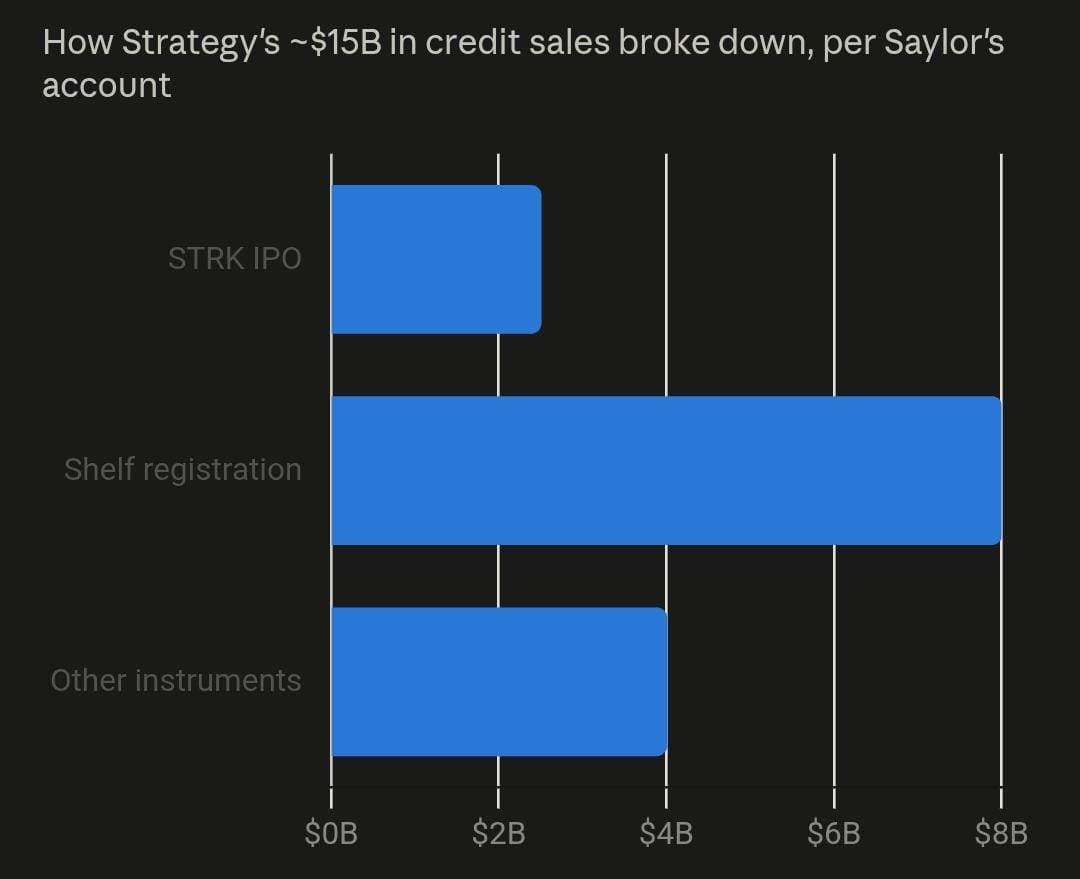
Here's where Saylor's account gets specific enough to actually verify against Strategy's own disclosures. He said the STRK IPO became the largest offering of its kind to date, worth about $2.5 billion. From there, the company layered on a shelf registration that generated another $8 billion, plus roughly $4 billion raised through other related instruments, bringing the total to approximately $15 billion in credit sold, which Saylor equates to the company effectively making $15 billion.
Strategy's public filings back up the broader pattern of aggressive, sequential capital raising across multiple preferred stock lines throughout 2025, even if the individual figures Saylor cited blend several distinct offerings together. The company's STRC offering alone closed at $2.521 billion in gross proceeds that July, officially the largest U.S. IPO of 2025 to that point, detailed in Strategy's own press release here: Strategy Announces Closing of $2.521 Billion STRC Stock Initial Public Offering. Around the same period, Strategy also launched a separate $4.2 billion STRD at-the-market program, confirmed directly in its SEC disclosure here: Strategy Announces $4.2 Billion STRD At-The-Market Program — SEC.gov.
Beyond STRK: Strategy's Wider AI-Assisted Credit Machine
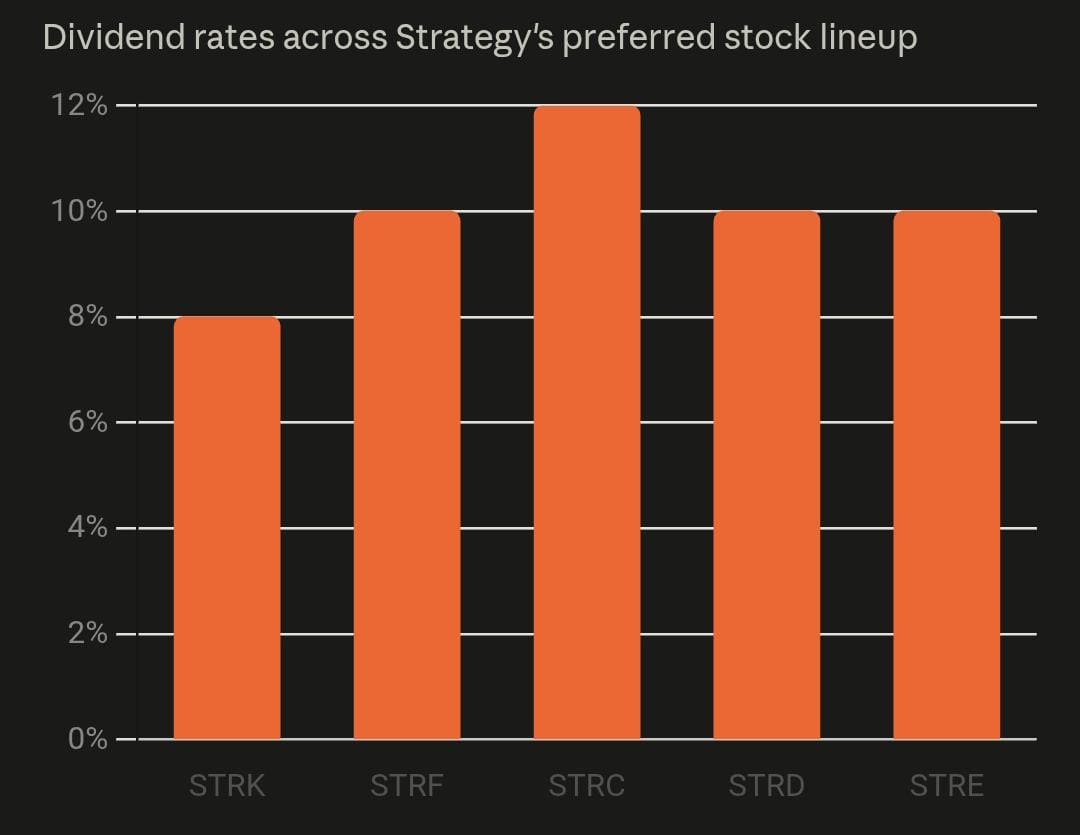
What I find genuinely notable, stepping back from the STRK story specifically, is that this wasn't a one-time maneuver. Strategy has continued stacking additional preferred instruments on top of STRK since, including STRF, STRC, STRD, and more recently a proposed STRE offering carrying a 10% dividend rate, each targeting a slightly different investor appetite for yield, seniority, or conversion upside. Strategy's own recent SEC filings confirm the company was still actively managing dividend rates and repurchase programs across this entire stack as of early August 2026, available directly here: Strategy Inc 8-K Filing, August 3, 2026 — SEC.gov.
Taken together, this reads less like a single AI-assisted breakthrough and more like an entire financing philosophy built around rapidly iterating new instruments, something Saylor's comments suggest AI has become a genuine part of the ideation process for, not just a novelty he mentioned once for a podcast soundbite.
What This Means For AI's Role In Corporate Finance
When analyzing Saylor’s bold claims and the novel headline of ChatGPT replacing investment bankers, the signal needs to be separated from the noise. The core takeaways reveal two distinct sides to this narrative:
- The Verifiable Reality: Strategy’s execution is backed by hard regulatory filings. The aggressive, multi-billion-dollar fundraising streak across perpetual preferred stock lines is documented, real, and mathematically massive.
- The AI Nuance: Saylor remains the single primary source for the claim that AI architected the instrument. It’s nearly impossible to verify how much structural innovation came from prompt prompts versus the human legal and banking teams who drafted, priced, and filed the securities.
- The Paradigm Shift: Whether AI acted as the master architect or simply an unconstrained brainstorming tool, it bypassed the cognitive friction of precedent. Wall Street operates on what has worked before; AI operates on what is mathematically and legally permissible within parameters.
The real takeaway isn't that an algorithm can write securities law single-handedly. It's that AI's true disruption in high-stakes corporate finance might lie in standard ideation, acting as a sounding board that isn't afraid to propose structures traditional advisors would dismiss out of habit.
Disclosure: This is not trading or investment advice. Always do your research before buying any cryptocurrency or investing in any services.
Follow us on Twitter @themerklehash to stay updated with the latest Crypto, NFT, AI, Cybersecurity, and Metaverse news!