
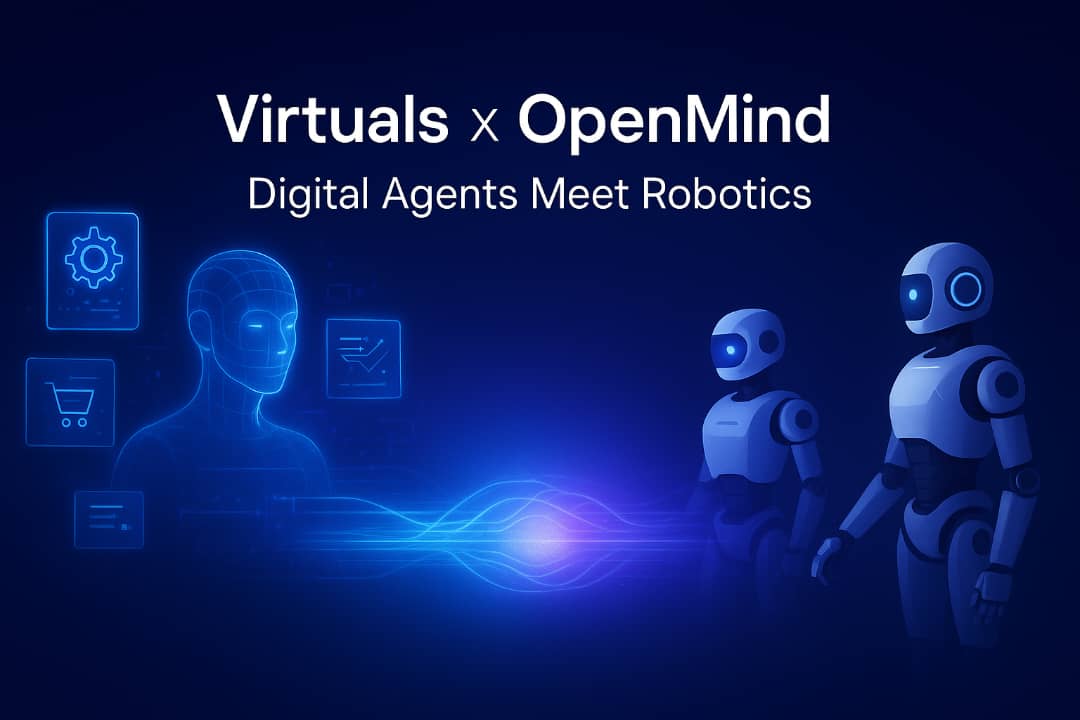
The future of AI is no longer forming in isolated silos. It is converging. And one of the most ambitious moves in that direction just arrived as Virtuals Protocol announced a strategic partnership with OpenMind, a robotics-focused AI layer positioned at the frontier of autonomous machine infrastructure.
Both teams confirmed the collaboration through coordinated posts on X, OpenMind’s announcement here and Virtuals Protocol’s statement here…
Virtuals Protocol is teaming up with @openmind_agi.
Together with OpenMind, we’re extending ACP into embodied AI by connecting software agents with real robots through a unified payment and coordination layer.
This integration brings robotics into the agent economy and lays the… pic.twitter.com/UMKlYZ6yrF
— Virtuals Protocol (@virtuals_io) December 8, 2025
The initiative aims to merge software agents with embodied AI, creating a unified digital-physical coordination layer. At its core, it’s a bet that the next era of AI will be one where autonomous agents don’t just think, transact, and plan online, they act in the real world through networked robots.
This partnership lays the foundation for that world.
A Unified Vision: Merging Agents and Embodied Intelligence
Virtuals and OpenMind share a clear idea of what autonomous AI should become. Not chatbots. Not isolated smart tools. But a vast network of agents and robots working together, coordinating, reasoning, and interacting economically across digital and physical environments.
Virtuals Protocol has been building toward this future with its Agent Coordination Protocol (ACP). ACP defines how autonomous agents communicate, negotiate, and collaborate while managing payments and workflow execution. The Virtuals system allows AI agents to:
- Reason independently
- Form plans
- Coordinate tasks with other agents
- Execute economic interactions
The goal is simple: an ecosystem where AI agents behave like rational digital entities.
OpenMind, meanwhile, approaches the same future from the opposite direction, the physical world. The team is constructing an open, decentralized robotics layer that gives robots:
- Verifiable identity
- Secure and tamper-proof coordination
- Autonomy over how they move, act, and respond
With OpenMind, robots aren’t coded as isolated devices. They become network participants.
The partnership brings these two visions together. The digital agent economy meets real-world robotics, not as two ecosystems, but as one.
Extending ACP to the Physical World
The technical core of the partnership lies in extending Virtuals’ Agent Coordination Protocol into the realm of embodied AI. Until now, ACP allowed software agents to coordinate and transact with each other. But with OpenMind, that same protocol can now interface with real robots.
That means:
- Agents can directly communicate with robots
- Robots can process missions from agents in real time
- Payments and incentives flow through the same unified layer
This creates a seamless digital-physical control plane where agents become the decision-makers, and robots act as the physical executors. The integration provides:
- A secure identity system for robots
- A verified transaction layer for actions taken
- A unified data stream for agents to interpret robot sensor information
Robots no longer operate as hardware devices. They join the agent economy as autonomous entities.
Robotics Enters the Agent Economy
The most immediate impact of the partnership is that robotics is gaining entry into the agent economy.
AI agents can now pay robots for services, assign them missions, and coordinate multi-robot tasks, all without human supervision. This opens the door to machine-to-machine (M2M) and machine-to-agent (M2A) transactions that occur naturally through economic incentives.
Examples of what becomes possible:
A Virtual agent paying a street-level delivery robot to pick up and drop off goods
Robots streaming real-time sensor data back to agents that adjust plans dynamically
Multi-robot task groups forming and dissolving automatically, depending on demand
Smart environments where agents coordinate dozens of devices at once
It’s not automation. It’s autonomy backed by economic logic.
Before this integration, robotics lacked a standard mechanism for economic coordination. With ACP extended to OpenMind’s robotic layer, robots are no longer static assets. They become market participants.
Software Agents Gain Presence in the Physical World
The inverse is also true: software agents now gain physical presence.
A single Virtual agent can:
- Plan a complex multi-step task
- Settle payments using native coordination rails
- Assign actions to any OpenMind-powered robot in the network
- Receive streaming sensor data in real-time
- Adjust missions based on environmental changes
This transforms AI agents from purely digital planners into physical-world operators.
An agent requesting a real-world action no longer needs a human or centralized API integration. It can directly instruct any compatible robot, pay it, verify completion, and update its plan.
What emerges is a world where:
- Agents hire robots
- Robots report back to agents
- Both operate within a shared economic and coordination system
This is the foundation of embodied autonomy, machines reasoning, acting, and transacting.
The Foundation for Autonomous Machine Interactions
The partnership creates a future where robots aren’t just following commands. They become intelligent, networked machines that serve as part of a larger agentic ecosystem.
This changes the robotics stack fundamentally:
Old model:
- Robots follow pre-coded instructions, limited by their own onboard intelligence.
New model:
- Robots operate as physical endpoints for distributed, reasoning AI agents.
- They coordinate with other machines through a unified identity and payment layer.
They plug into the same economic environment as software agents.
This opens the door to:
- Fully autonomous machine networks
- Decentralized logistics systems
- Self-optimizing industrial operations
- Smart-city robotics
- Autonomous service marketplaces
In this architecture, machines no longer wait for human intervention. They interact with each other, negotiate roles, and execute tasks as economically rational participants.
The Virtuals–OpenMind partnership is not about adding intelligence to robots or connecting agents to new APIs. It is about establishing the infrastructure for a machine-run economy.
A Step Toward the Next Era of AI and Robotics
The integration is still early, but the direction is unmistakable: the digital and physical layers of AI are converging into one cohesive machine ecosystem.
Virtuals provides the reasoning and coordination intelligence.
OpenMind provides the embodiment and secure identity layer.
Together, they are building the rails for machines that think, act, transact, and interact across both worlds.
The partnership marks one of the strongest attempts yet to unify autonomous agents with robotics at scale. It reflects a growing belief that the next phase of AI will not be cloud-bound. It will be physical. It will be autonomous. It will be economic.
And it will be built on open, interoperable layers like Virtuals and OpenMind.
Disclosure: This is not trading or investment advice. Always do your research before buying any cryptocurrency or investing in any services.
Follow us on Twitter @themerklehash to stay updated with the latest Crypto, NFT, AI, Cybersecurity, and Metaverse news!
