I bought LUNA at $87. I still have the confirmation screenshot somewhere, buried in a folder I haven't opened in years because I already know what's in it. What I want to walk through here isn't really about that trade, though.
It's about the six days that followed it, and why, even as the number kept falling, kept falling, kept falling, I didn't sell. Not at $60. Not at $30. Not even at $3, when any rational read of the situation should have screamed at me to take whatever was left off the table.
I've thought about those six days more than almost any other stretch of my trading history, because they taught me something about my own brain that no amount of technical analysis ever could.
The Chart That Still Makes My Stomach Turn
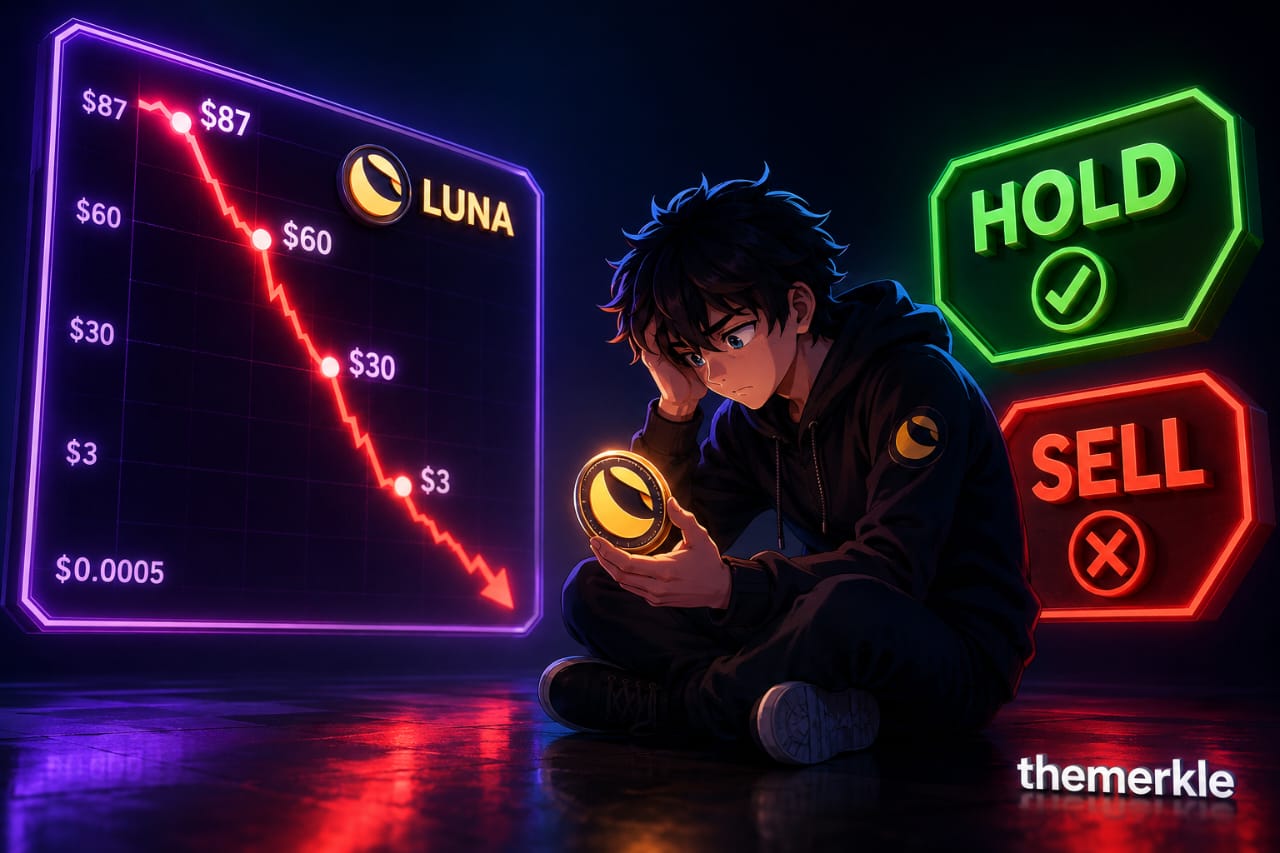
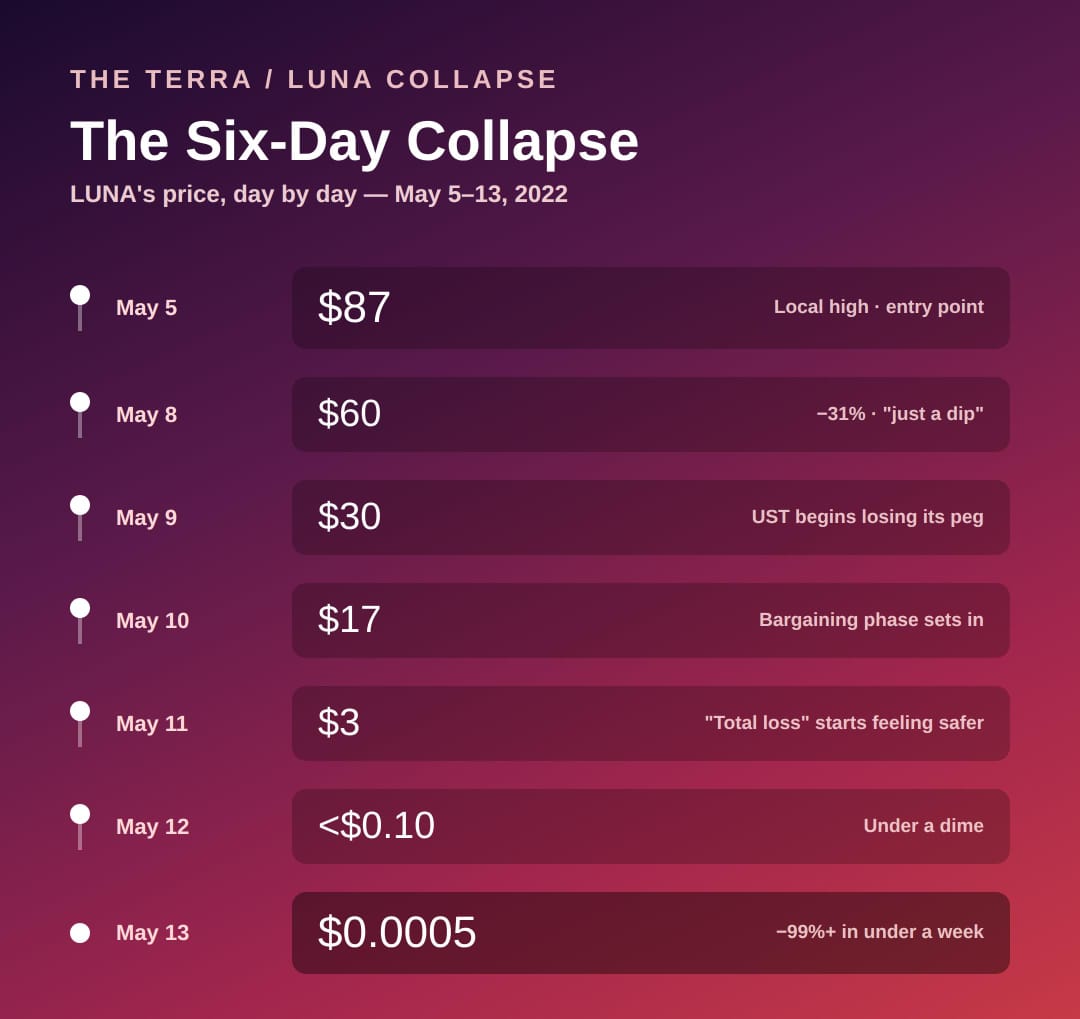
Here's the shape of it, laid out plainly. I bought in on May 5, 2022, near LUNA's local high of $87. By May 8, it had slid to around $60, a serious dip but nothing that felt catastrophic yet, crypto corrects 30% all the time. By May 9, the real unraveling had started, LUNA down near $30 as its paired stablecoin, TerraUSD, began losing its dollar peg. May 10 brought it to $17. May 11, $3. By May 12, it was trading for less than a dime. And on May 13, the number that had once represented my entry price had become $0.0005, a technical rounding error, a coin worth less than the electricity it took to check the price.
I held through every single one of those days. Not because I had a thesis. Because I couldn't make myself sell.
Why My Brain Refused To Pull The Trigger At $60
The textbook name for what happened to me is the sunk cost fallacy, the well-documented tendency to keep pouring resources, attention, or belief into something specifically because of what's already been invested, rather than what remains ahead. But knowing the name of a cognitive bias and feeling its grip while it's happening to you are two entirely different experiences.
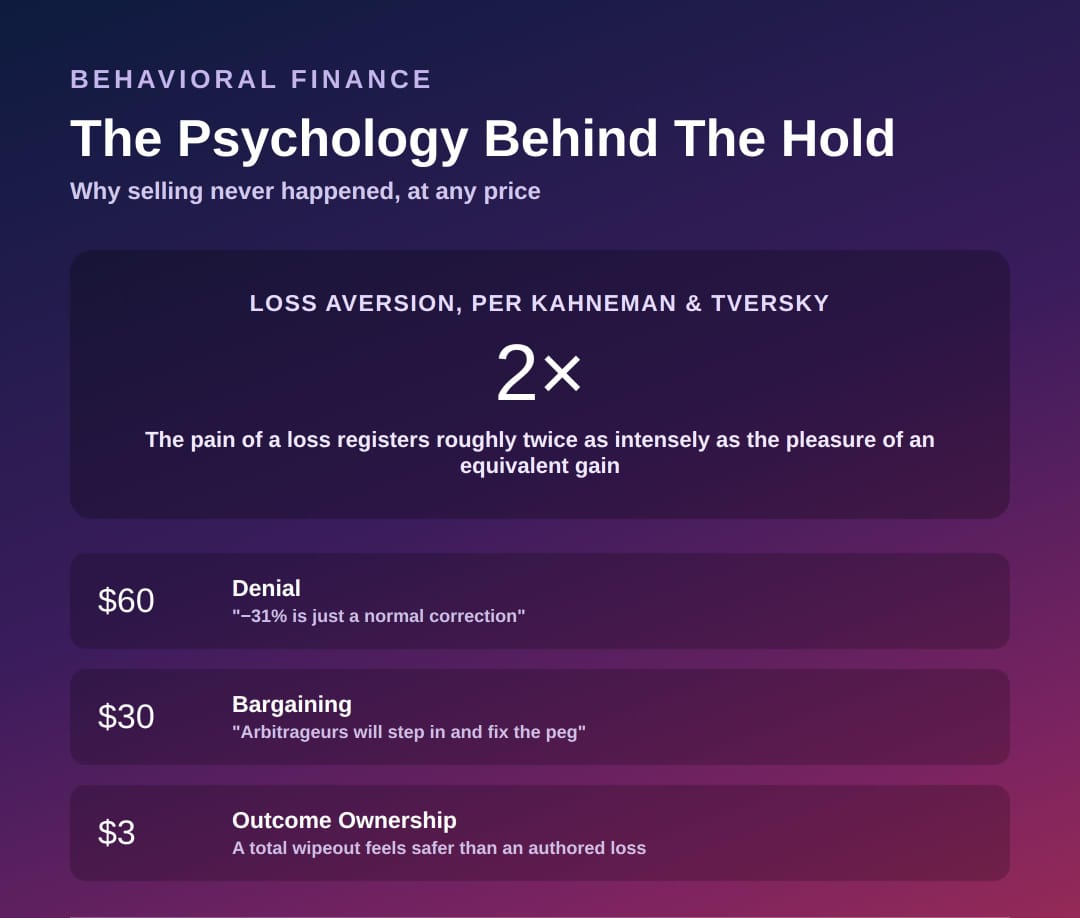
At $60, selling meant accepting a locked-in loss of roughly 31%. That's a number, a fact, something I could have written down and moved on from. But my brain wasn't processing it as a number. It was processing it as a verdict on a decision I'd made days earlier, and admitting the decision was wrong felt worse than the money itself. Behavioral economists call this loss aversion, the finding, first documented by Daniel Kahneman and Amos Tversky, that the psychological pain of a loss registers roughly twice as intensely as the pleasure of an equivalent gain. Selling at $60 wasn't just losing 31% of my money. It was manufacturing a moment of certain, undeniable regret, on a day when the alternative, holding, still let me pretend the story wasn't over yet.
The Bargaining Phase Nobody Warns You About
By $30, something else had kicked in, a kind of bargaining that felt, in the moment, indistinguishable from analysis. I remember telling myself the depeg was "probably temporary," that "arbitrageurs would step in," that a token backed by an entire foundation's reserves "couldn't actually go to zero." Every one of those thoughts sounded, to me, like reasoning. In hindsight, they were something closer to prayer, dressed up in market vocabulary to make the not-selling feel like a strategy rather than a freeze response.
This is the part of the sunk cost fallacy that rarely gets discussed honestly: it doesn't feel like denial from the inside. It feels like patience. It feels like conviction. The same qualities that make for genuinely good, disciplined investing, the ability to hold through volatility and resist panic, get hijacked and pointed in exactly the wrong direction, toward a position that's actively dying rather than one that's merely dipping.
Total Loss Started To Feel Safer Than Admitting Defeat
Here's the strangest part, and the one I think explains why so many traders ride a token all the way to zero instead of selling at, say, 70% down. Somewhere around the $3 mark, a full loss stopped feeling like the worst outcome and started feeling, perversely, like the more bearable one. If the position went to zero entirely, I reasoned, it would be a market catastrophe, something that happened to me, an event with a villain, a headline, a founder to blame. But if I sold at $3 and the coin somehow bounced, even fractionally, that would be a decision, my decision, permanently converting a paper loss into a story about my own bad judgment.
Psychologists sometimes describe this as outcome ownership. A total wipeout can be externalized, absorbed into a larger narrative about an entire market collapsing, everyone losing together. A voluntary sale at a loss can't be externalized the same way. It's authored. And it turns out, for a lot of traders including the person writing this, an authored loss feels heavier than an identical loss that simply happens to you.
What Actually Happened To Terra, And Where Its Founder Is Now
I want to be precise about the mechanics here, since the psychology only makes sense against the real timeline. TerraUSD, LUNA's algorithmically-pegged stablecoin, began losing its dollar peg on May 9, 2022, after a wave of large withdrawals from the Anchor Protocol triggered heavy selling.
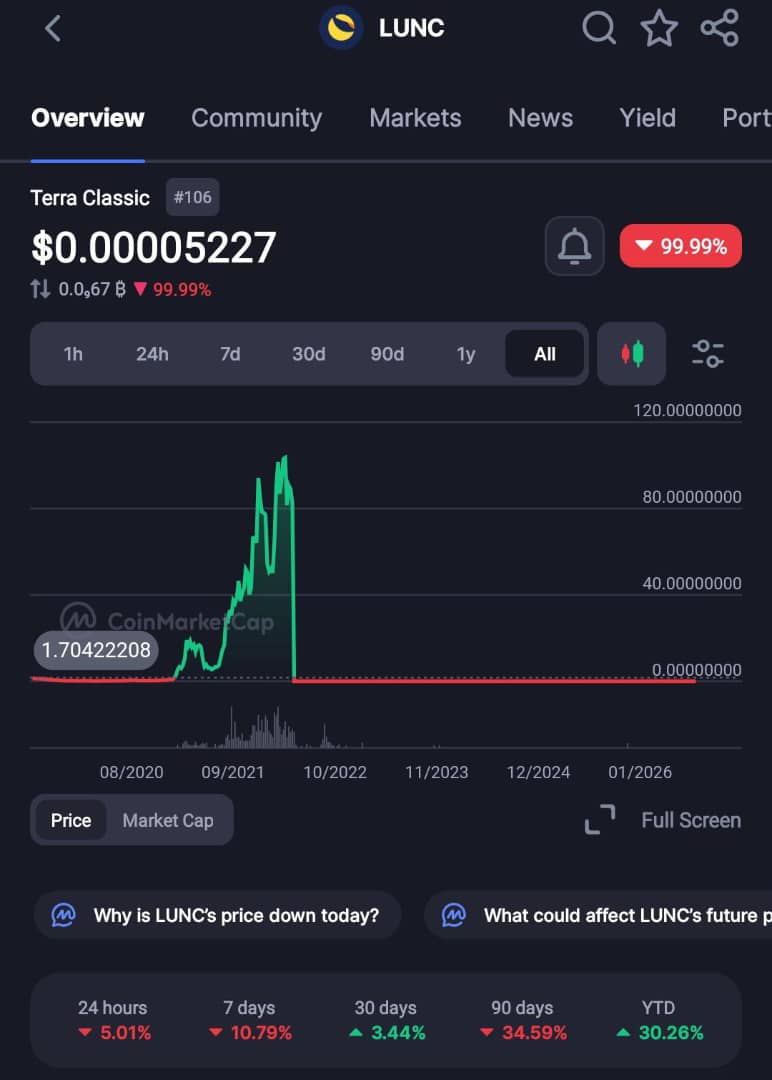
The Terra protocol's design meant that defending the UST peg required minting enormous new quantities of LUNA, and as billions of new tokens flooded the supply within days, LUNA's price collapsed by more than 99% in less than a week. Terraform Labs founder Do Kwon subsequently proposed a blockchain restart, published directly to Terra's own community governance forum, which you can read in its original form here. The proposal ultimately led to a network fork, splitting the original chain into what's now called Terra Classic. Anyone can independently verify the full historical price collapse through CoinMarketCap's Terra Classic data page, which still carries the complete record of that six-day collapse.
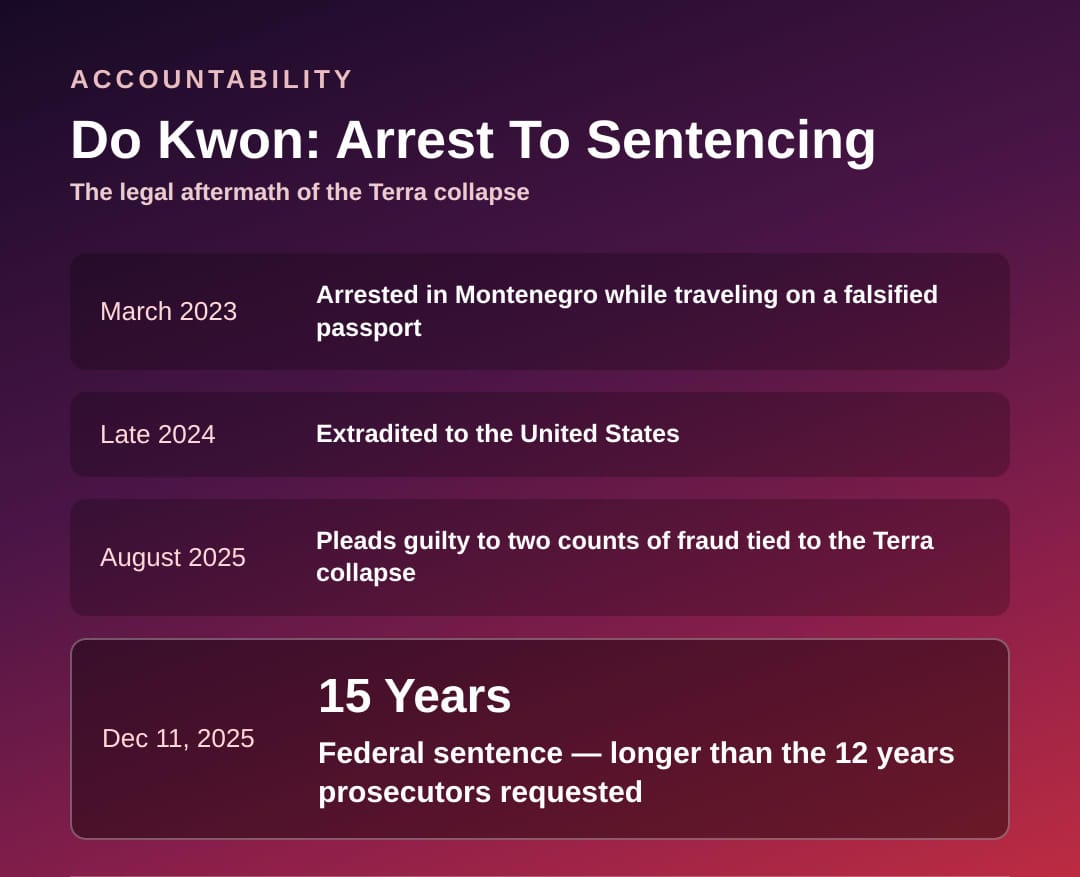
As for where Kwon himself ended up: he was arrested in Montenegro in March 2023 while traveling on a falsified passport, extradited to the United States at the end of 2024, and pleaded guilty in August 2025 to two counts of fraud tied to the Terra collapse.
On December 11, 2025, a federal judge sentenced him to 15 years in prison, longer than the 12 years prosecutors themselves had requested, calling the fraud one of the most damaging in the history of federal prosecutions. The official record of that sentencing comes directly from the U.S. Attorney's Office for the Southern District of New York, the agency that prosecuted the case, and is available here. Kwon still faces separate potential prosecution in South Korea once his U.S. sentence concludes.
The Only Lesson That's Actually Stuck
If there's a single takeaway I'd hand to anyone reading this while staring at their own bleeding position, it's this: the moment a loss starts to feel like an identity problem instead of a math problem is exactly the moment to distrust your own reasoning most.
A falling asset doesn't know what you paid for it, doesn't care about your entry price, and offers no reward whatsoever for the emotional consistency of having held it the whole way down. The sunk cost fallacy doesn't announce itself as fear. It shows up dressed as conviction, as patience, as the belief that admitting a mistake now would be worse than losing everything later. It's a lie that's felt exactly as true every single time I've told it to myself, right up until the number hits zero and there's nothing left to bargain with at all.
Disclosure: This is not trading or investment advice. Always do your research before buying any cryptocurrency or investing in any services.
Follow us on Twitter @themerklehash to stay updated with the latest Crypto, NFT, AI, Cybersecurity, and Metaverse news!