
Pyth Network is taking a decisive step toward sustainable value accrual.
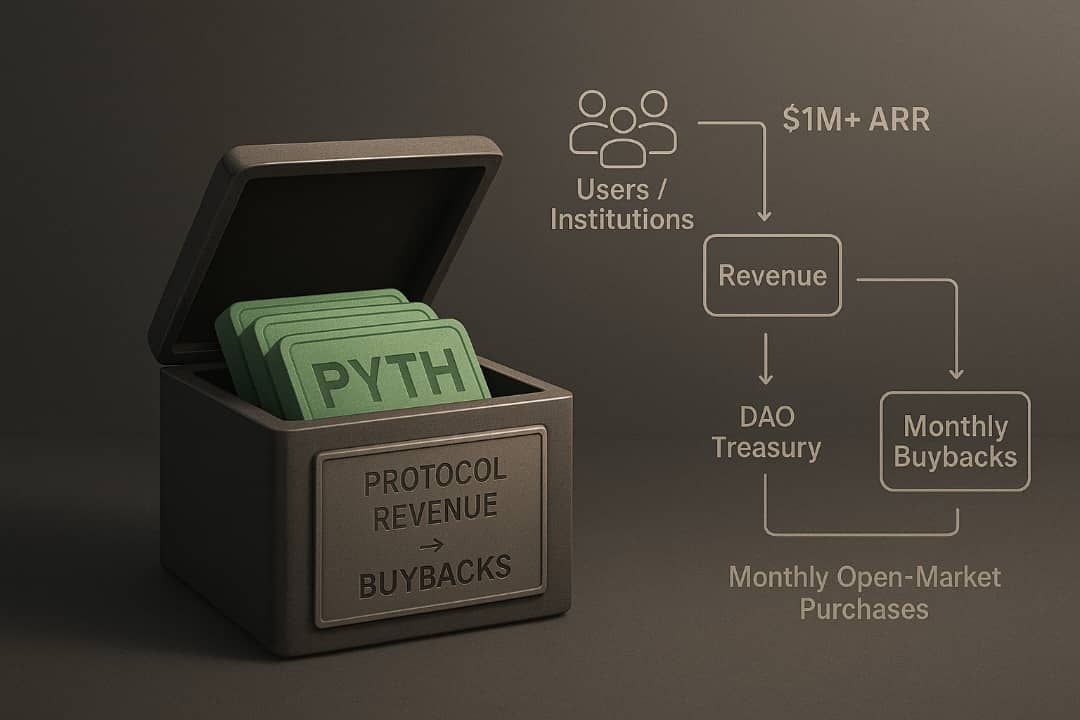
The oracle network announced the launch of monthly PYTH token buybacks, funded directly from protocol revenue and executed through its DAO treasury. The move comes as Pyth Pro surpasses $1 million in annualized recurring revenue (ARR) in its first month, marking a turning point for the project’s economic model.
For the first time, adoption at the protocol level now translates directly into systematic demand for PYTH on the open market. Not through emissions. Not through speculation. But through revenue.
The announcement, shared by Pyth Network, outlines a reserve strategy that ties growth, usage, and token economics into a single reinforcing loop.
From Infrastructure to Revenue Engine
For much of the past year, PYTH has struggled on price. The token is down roughly 80% from previous highs, reflecting broader market conditions and a long phase where infrastructure adoption outpaced visible value capture.
That backdrop makes the timing notable.
Pyth is no longer positioning itself solely as critical infrastructure. It is now operating as a revenue-generating network with paying customers and predictable cash flows. And those cash flows are being redirected back into the ecosystem.
Under the new framework, Pyth will convert a portion of protocol revenue into monthly open-market purchases of PYTH, using 33% of the DAO treasury each month. The structure is deliberately simple. The implications are not.
This is not a one-off buyback announcement. It is a standing mechanism.
How the PYTH Reserve Works
The PYTH Reserve introduces a clear and repeatable flow of value:
Ecosystem revenue → PYTH DAO treasury → monthly PYTH purchases on the open market.
Every month, the DAO deploys one-third of its treasury to acquire PYTH tokens directly from the market. Those purchases are not discretionary. They are programmatic.
Every quarter, the Pythian Council reviews pricing across the network’s core products , Pyth Core, Entropy, and Express Relay , adjusting fees to maximize long-term revenue while maintaining adoption.
The result is a closed-loop system.
Growth leads to revenue.
Revenue leads to purchasing power.
Purchasing power strengthens the network.
And the cycle repeats.
Where the Revenue Comes From
Pyth’s economic engine is powered by four products, each addressing a different segment of the data and execution stack.
Pyth Pro is the most significant signal so far. Launched as a premium institutional product, it surpassed $1 million in ARR in its first month, immediately validating demand from professional market participants. This revenue now directly fuels PYTH buybacks.
Pyth Core, the flagship oracle service, operates across 100+ blockchains, generating recurring onchain revenue as more applications adopt first-party price feeds as default infrastructure. As DeFi matures, reliance on high-frequency, low-latency price data continues to grow.
Entropy is gaining traction as a randomness provider for gaming, prediction markets, and Layer 1 networks. Secure randomness remains a critical primitive, and Entropy is increasingly embedded in production systems.
Express Relay serves venues that require low-latency blockspace and competitive execution, positioning itself as critical infrastructure for performance-sensitive environments.
Four products. One revenue stream. One reserve.
Why Pyth Pro Changes the Equation
The broader opportunity Pyth is targeting is enormous.
Globally, institutions spend over $50 billion per year on market data. Legacy providers dominate the space, charging as much as $250,000 per month for fragmented, delayed, and opaque feeds.
Pyth Pro flips that model.
One transparent subscription.
Every asset class.
Updated every millisecond.
Data sourced directly from the traders who set the price.
Even modest penetration changes the math. Capturing just 1% of the institutional market would translate to $500 million in ARR. Under the new reserve structure, every additional dollar of revenue increases the scale of monthly PYTH purchases.
This is why Pyth Pro matters beyond its first revenue milestone. It turns institutional adoption into a direct driver of token demand.
A Self-Reinforcing Flywheel Takes Shape
Phase 1 of Pyth’s journey proved the infrastructure worked. The network scaled. The data was reliable. Developers integrated it across chains.
Phase 2 proved something more important. Institutions are willing to pay for it.
The PYTH Reserve now activates the final piece of the puzzle. Adoption no longer stops at usage metrics. It flows into revenue. That revenue flows into systematic buy pressure. And that pressure reinforces the network’s economic security and long-term incentives.
More adoption leads to more revenue.
More revenue leads to larger purchases.
Larger purchases strengthen the network.
This is how sustainable crypto networks are built. Quietly. Mechanically. Without hype.
Market Perception and the Road Ahead
Launching buybacks after a prolonged drawdown raises questions. Some will see the timing as opportunistic. Others will view it as overdue.
What matters more is durability.
Pyth is not promising future cash flows. It is deploying existing ones. The buybacks are funded by real customers paying real fees for real services. That distinction is critical.
As the ecosystem accelerates and Pyth Pro adoption expands across global institutions and top-tier DeFi protocols, the reserve grows in parallel. The network moves from theory to execution.
The shift marks a clear evolution in how oracle networks think about value. Not as something deferred. But as something activated.
And for PYTH, that activation has now begun.
Disclosure: This is not trading or investment advice. Always do your research before buying any cryptocurrency or investing in any services.
Follow us on Twitter @themerklehash to stay updated with the latest Crypto, NFT, AI, Cybersecurity, and Metaverse news!
