
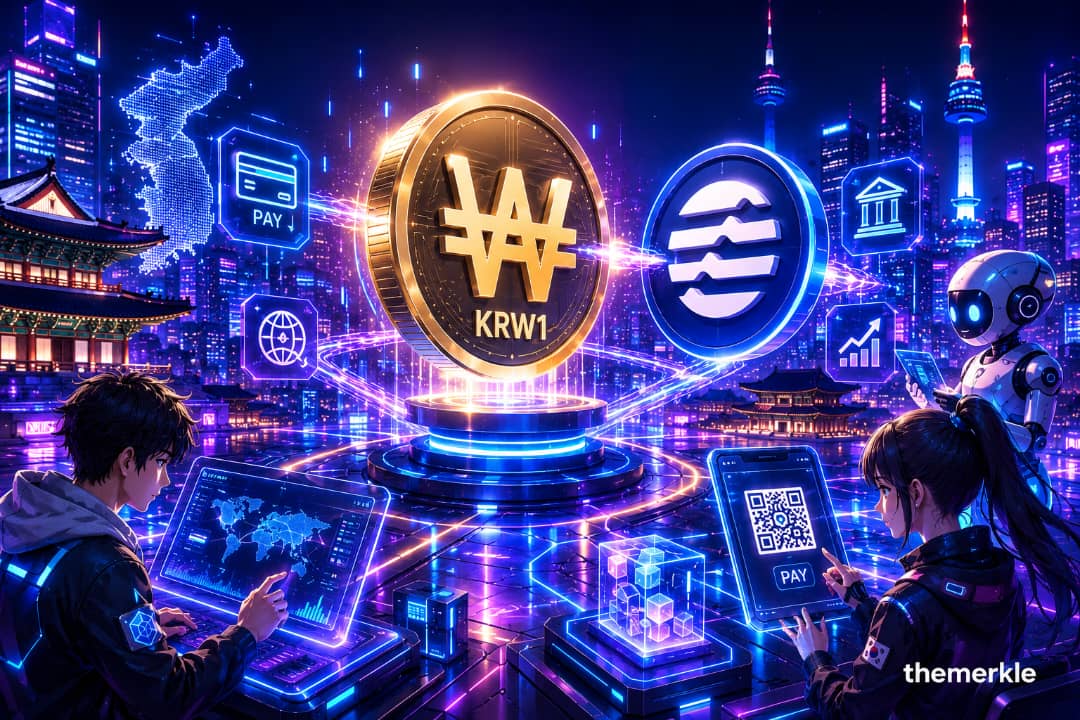
South Korea’s nascent crypto ecosystem has taken a big step toward onchain finance with the formal launch of KRW1, the world’s first stablecoin pegged to the Korean won powered by the top layer-1 blockchain Aptos.
For the first time, KRW1 is available outside of Ethereum Virtual Machine (EVM) compatible chains enabling fast payments, remittances and real-world asset tokenisation on a low-cost blockchain infrastructure built for massive financial activity.
This integration announcement came on the heels of an exploration by BDACS and the Aptos Foundation, with both sides touting the launch as a significant step for Korea’s nascent digital asset economy. This announcement further establishes Aptos as a high-throughput Layer 1 blockchain ever more aligned with institutional finance, AI-financed systems and payments infrastructure.
According to an official statement from Aptos, KRW1 is expected to run on rails designed for “markets and machines,” as the blockchain sector folds in on itself, with settlements remorsless in economies built around payment systems as well as basket-style stablecoins where near-future payments will be made by AI giants, machines growing autonomous being driven into a financial stack.
The launch represents a growing trend among stablecoin issuers to diversify away from Ethereum-scaled ecosystems in an effort for higher throughput and lower latency, and scalable infrastructure that can power real-world commerce. Aptos said the launch, completed in testnet at the end of 2023, further cements its home apace for digital finance across Asia with plans to deliver world first KRW-pegged stable coin.
KRW1’s First Non-EVM Deployment: Aptos
With KRW1 making a long-anticipated debut on Aptos, this is an unusual move for BDACS considering the stablecoin’s previous blockchain integrations. Stablecoins have always interacted primarily with EVM compatible networks, keeping within the confines of developer comfortability and accepted DeFi interoperability.
On the other hand, Aptos decenters a unique selling focus around throughput, low latency, and infrastructure optimized for institutional-grade applications. It has sought align itself with both traditional financial service functionality and AI-driven autonomous systems that operate at machine speed.
BDACS described the collaboration as a chance to expand KRW1 use cases from traditional blockchain applications into wider financial purposes. This integration powers onchain commerce, real-time payments and potential future tokenized asset frameworks connected to the Korean market.
With this in mind, many industry analysts consider Asia to be the prime long-term target market for stablecoin adoption, especially in those countries where habitual reliance on digital payments has solidified within daily living. Given South Korea’s sophisticated digital economy and engaged base of crypto active users, it is an optimal region for launching a localized stablecoin.
KRW1 has two main types of users: KRW holders who need on-chain liquidity, and DeFi users seeking a stable base currency to collateralize positions across protocols. The expansion of KRW1 is also a part of the wider evolution for stablecoins from simple trading instruments to suite-wide settlement layers enabling payments, treasury management, remittances and tokenized financial products.
Infrastructure for Payments and Commerce with Stablecoins
KRW1-Aptos integration is more geared toward practical finance rather than speculation. Both organizations highlight the role of the stablecoin in supporting payment networks, cross-border remittances, and tokenized real-world assets settled directly on-chain.
Stablecoins pegged to exotic local fiat currencies are progressively being acknowledged as important cements for blockchain acceptance, facilitating a digital asset that can be more easily integrated with regional economies. Though USD stablecoins like USDT and USDC dominate worldwide markets, localized stablecoins offer added seamlessness in integrating the blockchain ecosystem with national payment ecosystems.
KRW1 immortalises Aptos as one of the first chains with a substantive use case focused on real financial transactions rather than speculation.
This merger accordingly fits Aptos strategic vision of optimizing blockchain for both human users and autonomous agents. Since AI agents are expanding their ability to autonomously negotiate deals, self-execute them through payments as well as communicate directly with decentralized applications without any human influence in the loop, strong albeit high speed stablecoin protocol have become imperative for the entire industry.
The implementation of KRW1 might also serve as a springboard for future projects utilizing tokenized real-world assets inside South Korea’s financial ecosystem. The launch of the stablecoin on Aptos is a strong indicator that the blockchain wants to become an important execution layer for these next-generation financial systems.
Escalating The Crypto Market in Korea
Despite the gloomy news from South Korea, it still appears to be one of the largest crypto markets globally, with high retail investment continuing across trading as well as blockchain gaming and payments and DeFi. South Korea has historically outperformed many Western markets in terms of retail adoption, while institutional interest is thriving under a clearer regulatory environment.
Also, the announcement mentioned the great interest that Korea has had in crypto and classified it as one of the strongest blockchain user markets in addition to having a very active engagement with crypto.
The collaboration aims to bring blockchain-based payments and commerce increasingly within the reach of everyday Korean users and enterprises by embedding native KRW stablecoin rails directly on Aptos. Local actors do not need to depend on dollar-denominated stablecoins because they are able to settle with digital assets denominated in a currency that is fundamentally interwoven into their daily economic activities.
Through its custody and compliance architecture, BDACS focuses on regulated digital asset services for enterprise and institutional customers adding another crucial institutional dimension to the ecosystem.
In parallel, the Aptos Foundation is also scaling its blockchain infrastructure across payments, DeFi and AI powered applications. Regulated custody combined with scalable blockchain performance will be steadily more important as the integration of stablecoins into mainstream financial systems deepens.
Turning Up the Heat on Real World Blockchain Application
KRW1 on Aptos Deployment Similarly, this also shows the trend where there will no longer be a fight between Mainnets only based on speculation but rather based on real practical usage across networks!
Stablecoins have slowly become the backbone of many parts, and now an entire sector in, the crypto ecosystem, serving as liquidity for decentralized finance, payments, tokenized assets, and just in time for AI!
With governments, institutions, and enterprises increasing their consistency in blockchain integration; infrastructure that can support rapid, scalable stablecoin activity becomes vital.
In the last year, Aptos had a dive into this narrative and taking aim at AI infrastructure, autonomous agents, institutional settlement, payments systems etc. KRW1 being added further solidifies this positioning, giving South Korea a native stablecoin based on its high-performance blockchain.
This partnership highlights the increasing importance of local stablecoins for the larger crypto industry. Instead of depending on dollar-based liquidity alone, blockchains now integrate with regional currencies and local capital flows more directly.
Disclosure: This is not trading or investment advice. Always do your research before buying any cryptocurrency or investing in any services.
Follow us on Twitter @themerklehash to stay updated with the latest Crypto, NFT, AI, Cybersecurity, and Metaverse news!
