
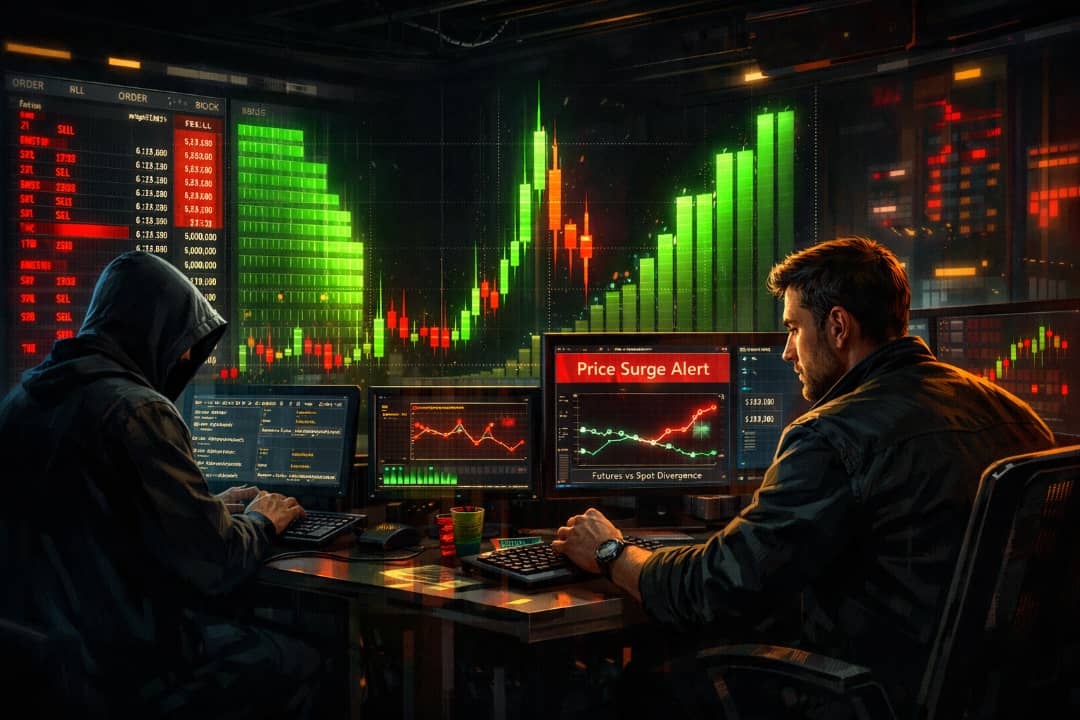
A sophisticated market manipulation attempt unfolded on Binance as a hacker gained control of a market maker’s accounts and attempted to move stolen funds through coordinated trading activity.
The attacker’s objective was clear: convert compromised capital into clean liquidity by engineering an artificial price surge in a low-liquidity token.
To execute the plan, the hacker selected $BROCCOLI(714), a thinly traded asset with shallow order book depth, making it highly susceptible to price distortion. According to on-chain analysis shared by Lookonchain, the attacker initiated aggressive spot market buying, while simultaneously opening long perpetual futures positions across multiple accounts in a textbook wash-trading and self-trading maneuver designed to lift derivatives pricing in tandem with spot action.
It appears a hacker gained control of a market maker's accounts on Binance and attempted to move stolen funds by manipulating $BROCCOLI(714).
Smart trader Vida(@Vida_BWE) managed to profit $1M from the hacker's operation.
What happened? ⬇️
About 8 hours ago, a hacker gained… pic.twitter.com/mjZ0jjyrJw
— Lookonchain (@lookonchain) January 1, 2026
The method follows a familiar pattern in exchange-level exploits: buy spot using stolen funds, leverage futures exposure elsewhere, and route value through coordinated trades that obscure the original source of capital. But this time, the manipulation did not go unnoticed.
Why $BROCCOLI(714) Became The Target
The choice of $BROCCOLI(714) was not random. At the time of the incident, the token carried a market capitalization of roughly $40 million, with limited liquidity and fragile depth across centralized venues. These conditions make it easier for large buyers to dominate the order book and force sharp price movements with relatively less capital.
As the hacker deployed funds, Binance’s spot order book rapidly filled with massive bid walls, at one point showing over $26 million USDT in buy orders, an extraordinary figure for a token of that size. In contrast, futures depth remained extremely thin, with just $50,000 USDT at the 10% bid level, creating a dramatic divergence between spot and derivatives pricing.
Such imbalances rarely occur organically. Experienced traders recognize them as warning signs of either a compromised account or a malfunctioning market-making algorithm. In this case, the scale and persistence of the bids strongly suggested the former.
Vida’s Alert Systems Detect Abnormal Price Action
One trader was already prepared. Vida (@Vida_BWE), a seasoned market participant, had built automated alert systems precisely to catch these types of anomalies. His setup included triggers for 30% price moves within 1,800 seconds and real-time spot-perpetual futures divergence monitoring.
When $BROCCOLI(714) began to spike violently, both alert systems activated simultaneously. Vida immediately recognized the situation as abnormal and rushed to his terminal.
At the time, Vida already held significant exposure. He had accumulated a $200,000 long-term position in $BROCCOLI(714) at an average cost of 0.016, acquired in early November. He also maintained a $500,000 BROCCOLI714/USDT perpetual futures position around 0.015, structured as a funding-rate arbitrage trade.
The sudden price surge caused his previously hedged positions to drift heavily out of balance. His $500,000 futures hedge ballooned into an $800,000 spot valuation, presenting an immediate opportunity to lock in $300,000 in risk-free profit. But Vida hesitated. The move felt wrong.
Reading The Order Book And Exploiting The Pump
Rather than exit immediately, Vida examined the order book more closely. What he saw confirmed his suspicion. Binance’s spot market displayed $5 million in bids within 10% depth, while futures liquidity remained negligible. Soon after, that figure expanded further, revealing the now-infamous $26 million USDT bid stack supporting the price.
“No rational whale trades like this,” Vida later explained. No sophisticated trader ignores spreads and pumps spot liquidity at scale without an exit strategy. The only logical explanations were a hacked account or a catastrophic market-making bug.
Recognizing the hacker’s intent, to pump spot, lift futures prices, and exit leveraged positions, Vida adjusted his strategy. He kept one screen locked on Binance’s live order book, knowing that as long as the massive bid walls stayed in place, price momentum would continue upward.
At first, Binance’s perpetual contracts triggered a circuit breaker protection mechanism, allowing only position reductions. Spot prices surged to 0.07, while Binance futures were artificially capped near 0.038. Meanwhile, Bybit contracts raced ahead to 0.055.
Vida patiently attempted to enter long positions every 5–10 seconds, waiting for the circuit breaker window to expire. When the restriction lifted, he successfully added approximately $200,000 in long exposure at an average entry of 0.046.
The Turning Point As Binance Risk Controls Step In
Manipulation-driven rallies always end the same way, suddenly. Vida knew the collapse would come the moment Binance’s risk control team intervened.
The first warning sign appeared when the hacker briefly canceled the massive spot bids around 04:20 China time on January 1, 2026. Interpreting this as potential account sanctions, Vida immediately activated his trading program and began liquidating aggressively, selling both spot and futures positions at any available price.
The result was decisive. His combined $400,000 total exposure, including both long-term holdings and chase positions, unwound into roughly $1.5 million USDT in realized value. Minutes later, the hacker attempted one last push, restoring bids and driving the token as high as 0.15. Vida stayed out.
He knew the ending was inevitable.
At 04:31, the bids vanished again. By 04:32, they were completely withdrawn, and this time, they did not return. Community chatter confirmed it: Binance had likely sanctioned the account.
That was the final signal. Vida opened a nearly $400,000 short position on Binance futures around 0.065, riding the collapse as $BROCCOLI(714) plunged to 0.02. The trade sealed the outcome.
A New Year Trade That Delivered A Million-Dollar Lesson
On the first day of 2026, Vida closed the episode with $1,000,000 in profit, extracted not from insider access or privileged information, but from discipline, preparation, and deep market understanding.
The story, which Vida later shared publicly on X, stands as a clear example of how alert systems, order-book analysis, and execution control can turn chaos into opportunity.
It also underscores a broader reality in modern crypto markets. As attackers grow more sophisticated, exploiting liquidity gaps and exchange mechanics, the line between security incident and trading event continues to blur. In this case, a hacker’s attempt to launder stolen funds through market manipulation ended up rewarding a trader who knew exactly what he was watching.
The lesson is simple but powerful: markets always leave fingerprints. And for those paying attention, even the most aggressive manipulation can become an edge rather than a threat.
Disclosure: This is not trading or investment advice. Always do your research before buying any cryptocurrency or investing in any services.
Follow us on Twitter @themerklehash to stay updated with the latest Crypto, NFT, AI, Cybersecurity, and Metaverse news!
