
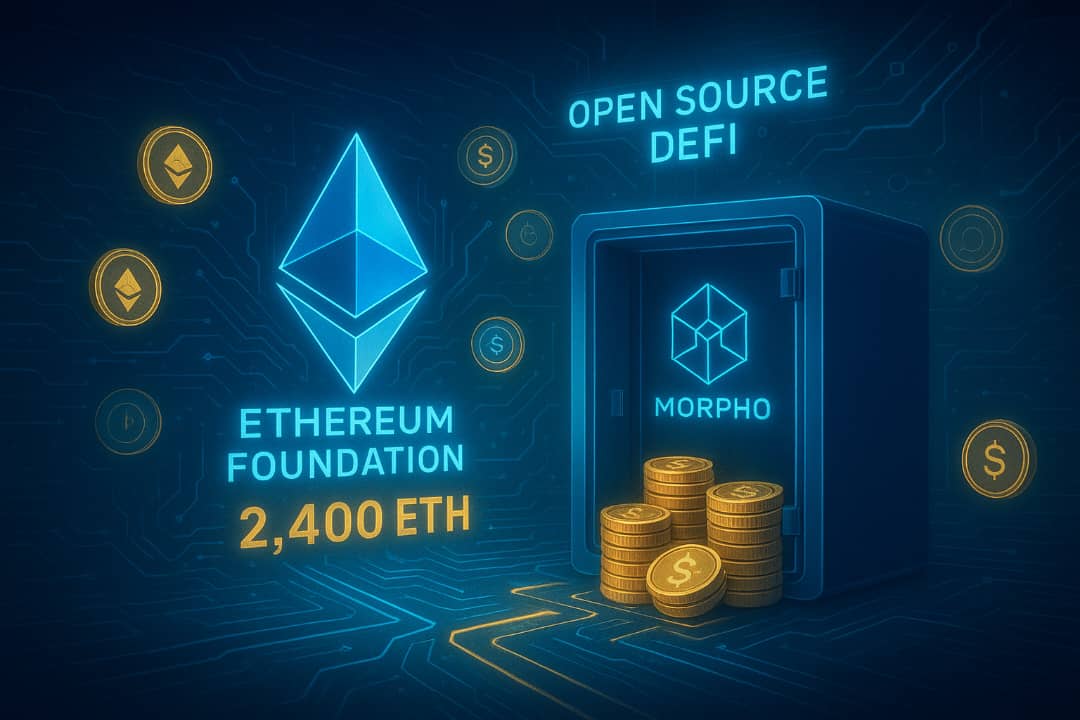
The Ethereum Foundation is deepening its decentralized finance (DeFi) engagement.
In a move that underscores confidence in open-source DeFi protocols, the Foundation deposited 2,400 ETH and roughly $6 million in stablecoins into Morpho’s yield-bearing vaults.
The transaction, announced today, marks a significant shift in how Ethereum manages its on-chain treasury, channeling part of its assets into permissionless, yield-generating infrastructure instead of traditional custodial holdings.
0/ Today, the Ethereum Foundation deposited 2400 ETH and ~$6M stablecoins into Morpho’s yield-bearing vaults.
Morpho is a pioneer in permissionless DeFi protocols and consistently demonstrates a commitment to Free/Libre Open Source Software (FLOSS) principles.
— Ethereum Foundation (@ethereumfndn) October 15, 2025
A New Phase for Ethereum’s Treasury Management
This isn’t the Foundation’s first DeFi experiment, but it’s the most visible yet. The decision to allocate ETH and stablecoins into Morpho vaults signals growing confidence in smart contract-based asset management.
Morpho’s architecture allows treasury deposits to earn optimized yield while maintaining self-custody, a key consideration for institutions that prioritize transparency and control.
For Ethereum, this is also symbolic. The Foundation isn’t just funding the future of decentralized technology, it’s now actively participating in it.
What is Morpho?
Morpho is a leading permissionless DeFi protocol built to enhance lending and borrowing efficiency across existing money markets.
It optimizes capital utilization by matching lenders and borrowers directly, reducing reliance on intermediaries and improving rates for both sides.
Morpho is more than a yield platform, it’s an open-source movement.
The team behind Morpho is a vocal supporter of FLOSS (Free/Libre Open Source Software) principles, ensuring that every version of its protocol remains accessible for builders to fork, audit, and improve.
Open-Source by Design
Morpho’s open-source approach sets it apart from most DeFi projects.
Its code is not just available, it’s licensed for freedom.
- MetaMorpho and Morpho Vault v2 operate under GPL 2.0, one of the most open and builder-friendly licenses.
- Morpho Blue (v1) currently runs under BSL 1.1, which will automatically transition to GPL 2.0 on January 1, 2026.
That means developers across the world will be free to fork Morpho’s codebase, extend its features, or build new layers on top, without permission or restriction.
This commitment to free software licensing is part of a broader philosophy: that DeFi must remain transparent, forkable, and community-driven.
The Ethereum Foundation’s deposit serves as both a strategic allocation and an endorsement of those principles.
FLOSS: The Foundation of a Free DeFi
For context, FLOSS (Free/Libre Open Source Software) licensing ensures that protocols like Morpho can be audited, forked, and replicated by anyone.
It’s what keeps DeFi resilient, ensuring no single entity can monopolize innovation or control protocol governance indefinitely.
By choosing Morpho, the Ethereum Foundation reinforces its stance on openness and developer freedom, core values that have defined the Ethereum ecosystem since launch.
Ethereum itself has always prioritized decentralization over profit. The Foundation’s latest DeFi allocation reflects that ethos in action.
Ethereum: Still the 1 Home for Developers
Alongside the treasury update, new data confirms Ethereum’s continued dominance among blockchain developers.
As of 2025, Ethereum remains the leading ecosystem for new developers entering crypto.
By a wide margin, developers still prefer building on Ethereum over other blockchains, a trend that shows no sign of slowing.
From DeFi to NFTs to Layer-2 rollups, Ethereum’s developer ecosystem remains the largest and most active in the world.
That developer strength is part of what allows open-source protocols like Morpho to thrive. Every improvement, every audit, every innovation compounds across thousands of contributors, all working toward the same decentralized future.
1/ New data confirms: @Ethereum is the #1 ecosystem for new developers in 2025. pic.twitter.com/ZThdbGDf0X
— Ethereum Foundation (@ethereumfndn) October 15, 2025
Why This Deposit Matters
The Foundation’s move is strategic, but also symbolic.
DeFi protocols like Morpho represent the next evolution of treasury management.
Instead of idle capital sitting in cold wallets, on-chain organizations can now earn yield, participate in governance, and directly support decentralized infrastructure.
For Ethereum, it’s a logical next step. The Foundation is proving that blockchain-native entities can manage funds transparently while generating returns, all without relying on banks or custodians.
The deposit also strengthens the narrative that Ethereum isn’t just a platform, it’s an economy.
An economy powered by decentralized finance, open collaboration, and composable innovation.
Institutional Confidence in Permissionless DeFi
The involvement of an entity as reputable as the Ethereum Foundation sends a strong signal to the broader crypto and institutional markets.
It demonstrates that permissionless DeFi protocols can be secure, efficient, and responsible enough to handle large-scale treasury allocations.
Morpho’s reputation for security, transparency, and code openness has made it a trusted name in DeFi circles.
Now, with the Ethereum Foundation as a depositor, that credibility only deepens.
For institutional players watching from the sidelines, this kind of on-chain engagement may serve as validation that DeFi is ready for serious capital.
Morpho’s design aligns with Ethereum’s broader vision, to turn finance into public infrastructure, accessible and composable by anyone.
By leveraging open-source licensing and decentralized architecture, Morpho ensures that the DeFi ecosystem stays inclusive and antifragile.
The Ethereum Foundation’s support signals belief not only in Morpho, but in the idea that DeFi protocols should belong to everyone, transparent, forkable, and community-maintained.
A Step Toward the Future of Decentralized Treasury
Ethereum’s choice to deposit 2,400 ETH and $6M stablecoins into Morpho’s vaults might look like a treasury move on paper. But in reality, it’s a statement.
It’s a vote of confidence in open-source finance, in permissionless innovation, and in the builders who make decentralized systems stronger every day.
Ethereum’s mission has always been about creating the infrastructure of a free internet economy.
By entrusting its funds to an open DeFi protocol like Morpho, the Foundation is showing the world what that future looks like, transparent, collaborative, and unstoppable.
The Ethereum Foundation continues to lead by example, not just funding development, but actively using the tools it helped inspire.
With Morpho’s open-source vaults, the Foundation’s treasury is now earning on-chain yield while supporting one of DeFi’s most principled projects.
And as Ethereum continues to dominate developer growth in 2025, this move reinforces a clear message:
- DeFi is maturing.
- Ethereum is evolving.
And the future of finance will be built in the open, just like the blockchain itself.
Disclosure: This is not trading or investment advice. Always do your research before buying any cryptocurrency or investing in any services.
Follow us on Twitter @themerklehash to stay updated with the latest Crypto, NFT, AI, Cybersecurity, and Metaverse news!
