
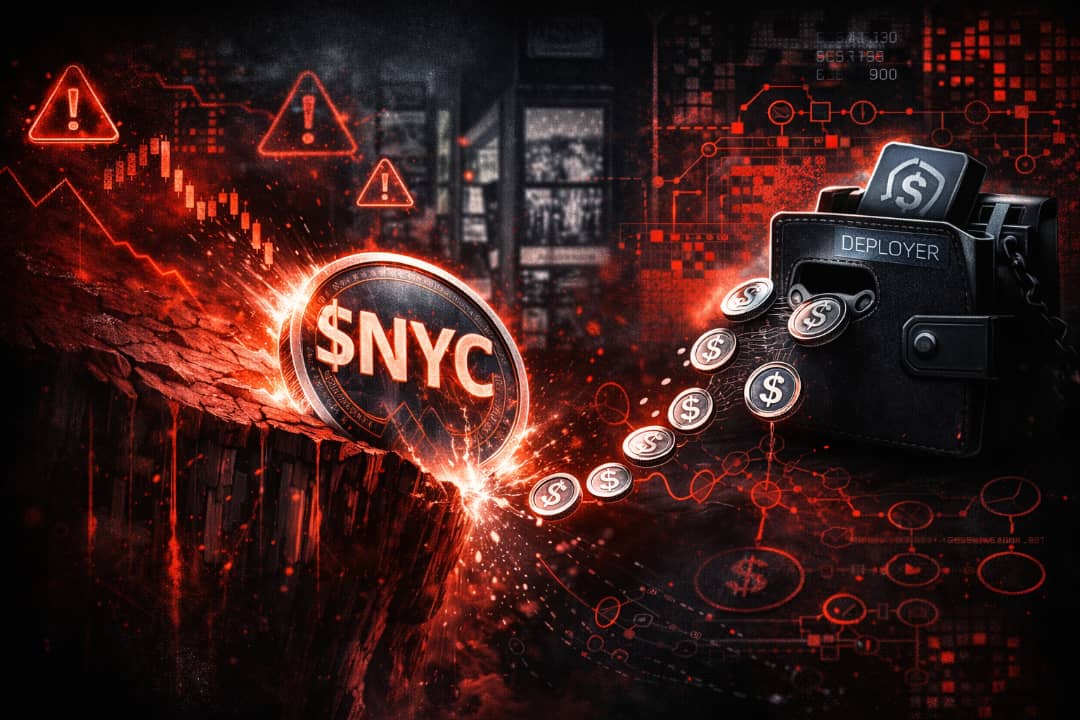
Former New York City Mayor Eric Adams launched the $NYC token this week, promoting it as a blockchain initiative designed to combat “antisemitism and anti-Americanism” and introduce young people to digital asset technology.
But within hours of its debut, the token’s market value collapsed, falling more than 81% from its peak as blockchain analysis platform Bubblemaps flagged suspicious liquidity movements involving a wallet linked to the token’s deployer.
🇺🇸 Former NYC Mayor Eric Adams launched $NYC today, claiming it would fight “antisemitism and anti-Americanism.”
The token has since fallen over 81% from its peak with @Bubblemaps flagging suspicious LP activity with the team extracting $1M by cycling liquidity. pic.twitter.com/rAcnjAzkLh
— GeckoTerminal (@GeckoTerminal) January 13, 2026
What began as a high-profile political and technological announcement in Times Square quickly turned into a controversy after analysts reported that a wallet associated with the project extracted roughly $1 million from liquidity pools through a pattern of cycling USDC in and out. The incident immediately raised questions about transparency, intent, and the structure of the token’s liquidity mechanisms.
Token Launch Generates Immediate Volatility
The token launched publicly on Monday, accompanied by an event where Eric Adams presented $NYC as a tool for social impact and education. The announcement triggered a rush of trading activity. According to Solscan data, the token’s market capitalization surged rapidly, briefly reaching $600 million shortly after going live.
But the rally was short-lived. Within hours, liquidity began to shift, selling pressure intensified, and the market cap plummeted below $100 million, settling near $110 million as the price collapsed more than 80% from its highs.
This dramatic price movement was not driven by typical market cycles, it aligned precisely with suspicious on-chain liquidity changes flagged by Bubblemaps.
Suspicious LP activity on $NYC 🚨
Launched by Eric Adams, former mayor of New York
The team extracted over $1M by cycling USDC in and out of the liquidity pools https://t.co/rJjXGgarUC pic.twitter.com/6XlJNaELe7
— Bubblemaps (@bubblemaps) January 13, 2026
The firm noted that wallet activity tied to the token’s deployment created a liquidity environment that inflated early momentum and then extracted capital as prices peaked.
Analysts Identify Wallet 9Ty4M As Key To Liquidity Movements
Bubblemaps began tracking the token immediately after launch and reported that the creator transferred 80 million NYC tokens into a wallet labeled 9Ty4M. This wallet was used to establish one-sided liquidity on the Meteora decentralized exchange, allowing the token to begin trading.
What followed raised red flags for blockchain analysts:
- Wallet 9Ty4M removed approximately $2.5 million USDC at the price peak
- After the token fell more than 60%, only $1.5 million USDC was added back
- Nearly $1 million remains unaccounted for
- No public explanation has been offered
The pattern indicates liquidity cycling, a maneuver where liquidity is strategically added and removed to influence market behavior. Analysts argue that cycling can artificially inflate confidence during early trading while allowing insiders to extract stablecoins at optimal moments.
The liquidity extraction also closely mirrors earlier incidents involving the launch of the LIBRA token, where analysts reported similarly aggressive liquidity manipulation.
Token Value Drops As Concerns Spread Among Investors
The market reacted sharply as details of the liquidity movements spread across social platforms and trading communities. With liquidity shrinking and selling pressure accelerating, the $NYC token began to experience severe volatility.
Market participants who bought near the peak watched their positions lose more than 80% in value within a short timeframe. The token’s market cap, once nearing $600 million, cascaded down to just over $110 million, erasing hundreds of millions in paper value.
Investors expressed frustration at the lack of communication from the project team regarding the liquidity withdrawals, with many noting that the absence of official clarification amplified uncertainty.
Meanwhile, blockchain analytics dashboards continued to show wallet 9Ty4M maintaining a significant amount of extracted USDC with no movement indicating a return or redistribution.
Public Messaging Contrasts With On-Chain Activity
The controversy surrounding the liquidity movements stands in stark contrast to the public narrative promoted during the token’s launch event. Adams described $NYC as a project built to advance civic values and educational goals, stating that proceeds would support efforts to combat antisemitism and anti-Americanism and help connect children with blockchain technology.
The project’s official website positions the token as a symbol of New York City’s innovation, diversity, and forward-looking culture. It frames $NYC as a community-focused digital asset designed to generate public benefit and foster engagement.
However, the on-chain activity reported by analysts introduces significant inconsistencies between the stated mission and the liquidity behavior. The timing of the extraction, occurring at the market’s peak, suggests intentional movement rather than routine operational adjustments.
The lack of an official explanation from Adams or the project management only heightened market suspicion.
Liquidity Cycling Raises Questions About Token Structure
Bubblemaps’ report highlights structural issues that go beyond the price drop. Analysts argue that liquidity cycling can distort early-stage market behavior by:
- artificially amplifying initial market cap
- attracting traders through misleading volume
- enabling early insiders to extract stable assets
- destabilizing price structure once liquidity is removed
- leaving retail investors exposed to rapid depreciation
The $NYC case demonstrates how quickly capital can move in and out when liquidity pools are controlled by deployer-linked wallets. As trading volume surged, the wallet withdrew more than $2.43 million USDC, suggesting that the early rally may have been supported by liquidity that was never intended to remain in the pool.
After prices collapsed, only $1.5 million USDC was returned, a move analysts say stabilizes the pool just enough to maintain functionality without restoring full liquidity.
This discrepancy of nearly $1 million remains a central concern for traders and analysts alike.
A High-Profile Launch Overshadowed By Transparency Concerns
What was meant to be a celebratory launch for a civic-themed token has quickly become a case study in liquidity manipulation and investor risk. Eric Adams’ association with the token elevated its visibility, but also magnified scrutiny.
The rapid extraction of liquidity from wallet 9Ty4M, the unaccounted $1 million, and the absence of a public explanation have overshadowed the token’s stated mission. As the market continues to digest the events, the $NYC token faces ongoing volatility, reputational pressure, and growing skepticism from crypto analysts and investors.
Whether the project can recover trust remains uncertain. For now, the spotlight remains firmly on the on-chain activity, not the message presented during its launch.
Disclosure: This is not trading or investment advice. Always do your research before buying any cryptocurrency or investing in any services.
Follow us on Twitter @themerklehash to stay updated with the latest Crypto, NFT, AI, Cybersecurity, and Metaverse news!
