Does the market have room for two thriving DApp platforms? Ethereum and EOS represent two distinct approaches to carrying out smart contracts and supporting more than 1,500 DApps.
Ethereum holds an advantage as the first native DApp platform, but EOS is proposing a much faster consensus model. Is there going to be one clear winner and loser, or does the marketplace have room to support both platforms thanks to their different strengths? There’s reason to believe both platforms can be successful; however, both have their work cut out for them.
[caption id="attachment_59113" align="alignnone" width="1920"]
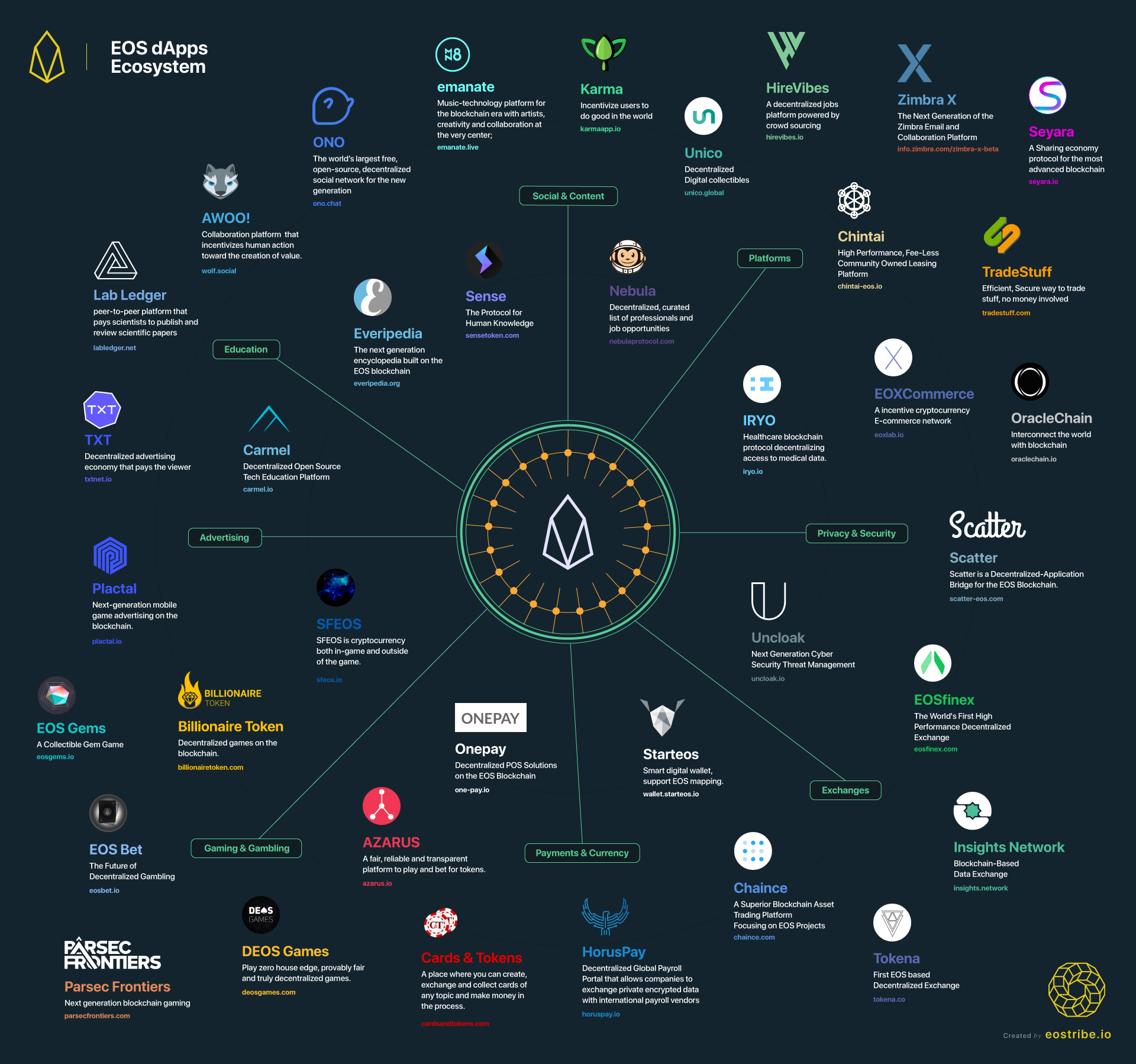
DApps coming to EOS, image by Raleigh Felton and
EOSTribe[/caption]
A Brief Comparison
Ethereum has already established itself as the most popular DApp platform, attracting massive amounts of developers thanks to its support for an easy-to-use programming language, Solidity, as well as a bevy of ICOs with ERC-20 tokens. It also boasts the most functional use cases of any crypto project in history, with more DApps coming to its mainnet each week.
EOS, meanwhile, held the largest ICO to date (US$4 billion) to support its development. The promises for its launch this weekend are substantial, and many are predicting everything that could go wrong. EOS plans to offer fee-less transactions and fast consensus right out of the gate, making it a tempting alternative if it can follow through.
EOS proposes several other changes separating it from Ethereum’s platform model, as shown below. Depending on your thoughts on governance models versus trustless architecture and security, they represent either benefits or drawbacks.
| Ethereum |
EOS |
- Functional and successful DApp community, ICOs, ERC-20s
|
|
- Currently supports 10 TPS up to about 16 TPS
|
|
- Lazy code costs consumers gas fees
|
- Dynamic pricing means devs - not consumers - pay for gas
|
- Straightforward transactions
|
- Option for transaction timelock delays, allowing cancels
|
- Solidity and Vyper for Python using EVM
|
- C++ and programming languages using WASM
|
- Immutable smart contracts - led to the Ethereum Classic fork
|
- Smart Contracts can be updated without causing the network to fork, but it's potentially a security risk if a developer or central authority can do this
|
|
|
- On-chain governance from day one
|
- Favors cryptoeconomics - reduces the number of social trust assumptions needed to operate
|
- Favors a voting system that could be subject to bribery but may cast out bad actors
|
- Highly decentralized - slow to reach finality as a result
|
- Somewhat centralized - 21 block producers
|
- Casper and sharding would add staking with a target of 20,000 TPS
- If met, that would be enough to handle enterprise-level software
- Needs to reach or surpass Visa’s 2,000 TPS average to be competitive with EOS
|
- 3-day staking period to vote locks up coins
- Will use “interblockchain communication” as sharding to handle enterprise-level software
- Compares favorably against Visa’s 2,000 TPS average - if it works
|
|
|
|
- Private keys can be lost or compromised, and there’s no way to reset them
|
- EOS provides an owner key that can reset a private key if it’s lost or compromised
|
- Protocol change is slow but methodical - will it be too late?
|
- Big promises and elaborate governance - will it work?
|
So, what will it take for Ethereum and EOS to achieve success?
Moving Forward: ETH and EOS
Ethereum needs scalability if it’s going to maintain its current huge role. Moreover, it’s going to require an immediate shift to compete with EOS’s promised capabilities. If EOS is able to do what its team says it will and also attracts a competitive volume of traffic, Ethereum could lose its stronghold. Fifteen transactions per second (TPS) isn’t going to cut it for mass adoption, so switching from a Proof of Work (PoW) model to a faster solution is urgently needed.
The results of EOS’s mainnet launch remain to be seen. The platform could thrive as a faster and more cost-effective alternative to Ethereum, but it also could suffer from its design, as Vitalik Buterin pointed out, criticizing its DPoS model for potential bribery in its voting structure.
EOS is structured to rely heavily on voters and a small group of block producers in order to achieve its promised millions of transactions per second. This model is a test: Will token holders actively govern its consensus mechanism, picking the right candidates and punishing bad actors? Will block producer candidates stick around, leveraging their massive CPUs to support EOS over the long term?
EOS token holders are powerful if they register their tokens and continually stake them to vote for block producers. But if staking proves to be too much hassle, only a fraction of the EOS community will be making these decisions, effectively centralizing them among a small, but perhaps highly informed group of active voters. This could be representative democracy at its finest, or a flop indicating insufficient interest in the platform. Will token holders embrace Dan Larimer’s requirement that they stake coins for three days without being able to convert them for the privilege of voting?
Ethereum
Ethereum is a top choice for DApp releases today, as well as a safe place to tokenize virtual and real property. CryptoKitties has already proven to be a successful virtual tokenization, and MakerDAO’s Dai is a stablecoin that's showing success on the Ethereum platform. Other projects like Augur and Digix are set to launch on the Ethereum mainnet soon, reflecting the continued growth of the Ethereum platform.
Despite all this exciting news, Ethereum has yet to scale past 15 TPS, and it needs to do so soon if it's to remain the leading DApp platform against EOS as well as competitive with Visa’s 2,000 TPS average.
Casper FFG - Bringing Staking to Ethereum
The Casper testnet was released in January and is predicted to run on the mainnet beginning this summer or fall. Casper FFG (the Friendly Finality Gadget) is touted as an improvement providing explicit finality so developers can better design DApps while wasting less gas. Casper isn’t a TPS solution, but it would allow the Ethereum blockchain to remain decentralized to a greater extent than EOS, while also reducing its total energy use by curtailing wasteful spends.
Casper also opens Ethereum to staking, allowing holders of 32 ETH or more (since the Mauve Paper) to stake tokens for a 5% annual return plus regular appreciation. This will free up massive amounts of ETH and produce more liquidity on the network, speeding up transactions.
Sharding
Sharding would pivot Ethereum away from its current Proof of Work model in which every single computer has to calculate and verify every transaction on the network. Ethereum’s massive popularity with respect to ICOs and DApp development has created a strong ecosystem, making it the most decentralized project in crypto's history in terms of node volume. Ethereum currently has over 25,000 nodes, more than any other blockchain and more than three times that of Bitcoin. This massive decentralized network has come at a price, however: slow consensus.
Sharding separates nodes to interact only within small subgroups or shards, like tiny separate islands, according to founder Vitalik Buterin:
In Ethereum sharding, there's no notion of shards being mapped to specific long-term node clusters or geographies etc; it's not like there's a Shanghai shard, Toronto shard, etc. All shards take their (frequently reshuffled) validator sets from globally dispersed nodes.
Each group interacts only with accounts in the same shard, decreasing the amount of time needed to form consensus by simply sharing receipts amongst trustless nodes that are all able to come to the same conclusion in regards to the money flow. Casper’s PoS model will help make sharding easier to manage, as it will require secure mechanisms to be sure which node has implemented which shard.
Once Ethereum launches Casper, sharding is supposed to be its next stepping stone toward faster transaction speeds, and it could very well beat EOS’s timeline if each step towards sharding goes smoothly.
DPoS from a Security Standpoint
Launching EOS with Delegated Proof of Stake right from the start, if successful, would give it a big advantage. DPoS creates a blockchain validated by a small group of ranked delegates known as block producers. EOS’s distributed operating system doesn’t rely on a massively decentralized supercomputer because it only needs a small consortium to validate its transactions.
Governance
While Ethereum is just starting to add governance features to its platform, EOS will launch with a governance model built in from the start. From a security standpoint, this makes it very difficult for EOS to fork. It also clarifies voting rules. For example, 15% of token holders need to vote in order for a chain to be considered valid. EOS has been criticized for having overly lax punishments when it comes to malicious violators.
Whereas Ethereum’s Casper would remove a validator’s stake for putting “nothing at stake” on two different chains, EOS has few repercussions. A validator on EOS would lose reputation, which could cost them their chance to be voted in as a block producer. Some critics feel a potential loss of earnings isn’t enough of a deterrent compared to getting tokens burned for bad behavior.
Criticism like this series of Twitter posts cites problems with the governance model and how these tasks will be moderated. EOS will need to demonstrate that its governance is a functioning model, responsive and adaptive in real time, not just a theoretical model as things stand now.
Conclusion
While EOS has promises to fulfill and Ethereum has updates in the works, both platforms have much work ahead. Whether you’re a strong supporter of Ethereum, EOS, or both, innovation is key to pushing the crypto economy forward, and both platforms have their work cut out for them.