
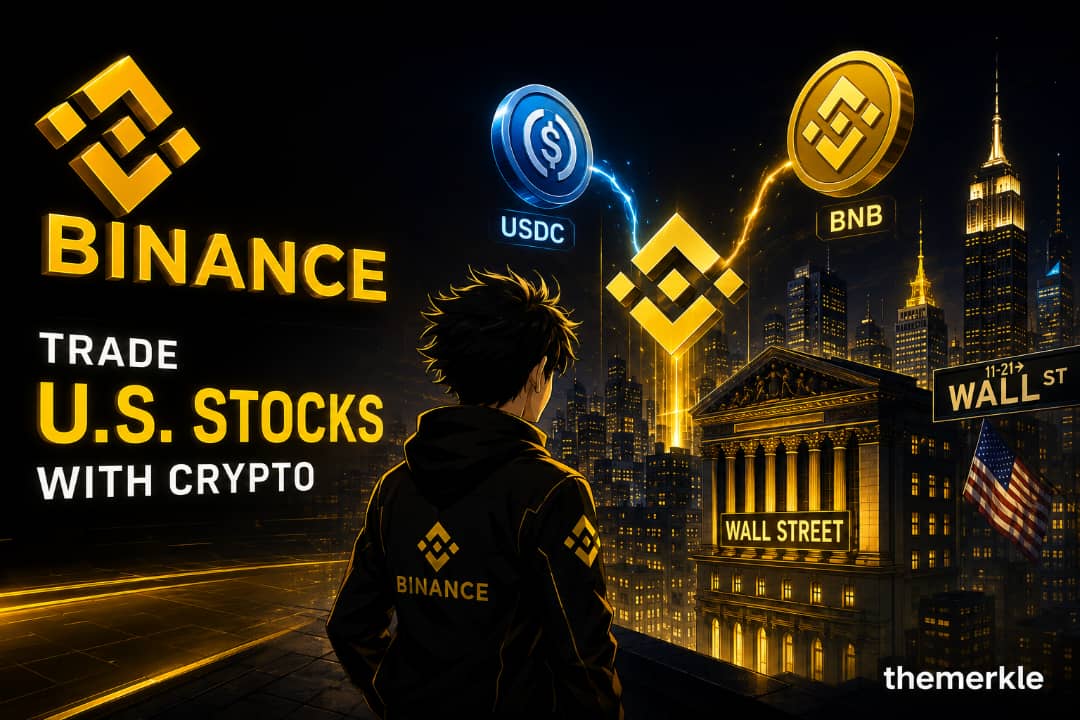
Binance just made a move that blurs the line between crypto exchange and traditional brokerage in a way nobody can ignore.
The world’s largest digital asset platform, serving over 300 million users globally, has officially launched US stocks and ETFs trading, and it is not available to US residents.
This is a product built entirely for the rest of the world, letting non-US users buy into American equities using crypto they already hold, through an interface they already know.
The full details of the integration, confirmed via Alpaca’s official announcement, reveal a product that is more complete than most people expected at launch.
What Binance is actually offering
The product lands with real depth. Users get access to over 7,000 US-listed stocks and ETFs, some sources put the number closer to 8,000, with fractional shares available from as little as $5. There are zero commissions on trades, and select equities are available for trading nearly around the clock, a nod to the 24/7 mindset that crypto users have grown up with.
Payment and settlement happen entirely in crypto. Users can fund their stock purchases and settle trades using USDC, USDT, or BNB, no bank account, no wire transfer, no traditional brokerage account required.
Trades are routed through broker-dealer Nest Trading, while custody is handled by Alpaca, whose Broker API powers the entire infrastructure sitting behind the product.
Alpaca’s infrastructure powers the whole thing
Alpaca is not a name that typically appears in crypto headlines, but it is doing serious work here. The company’s Broker API is what makes it possible for Binance to offer regulated access to US equities without building a traditional brokerage from scratch. Alpaca handles the custody side of the equation, keeping the product compliant while Binance focuses on the user experience and distribution its 300 million users already provide.
The architecture is worth understanding. Binance is not becoming a licensed US broker-dealer, it is plugging into existing regulated infrastructure through Alpaca and Nest Trading, then layering its own interface and crypto payment rails on top.
It is the same model that has allowed fintech companies to offer stock trading without becoming full-service investment banks, adapted for the world’s largest crypto exchange and its predominantly non-Western user base.
This is not Binance’s first step outside of crypto
What makes this launch land differently from a typical exchange feature drop is the context around it. Binance has quietly been building a multi-asset platform for some time. The exchange already offers derivatives tied to gold and petrochemicals, and it has moved into pre-IPO share trading in recent periods. Each of those expansions pushed the platform further away from pure crypto and closer to something that looks like a full financial services app.
The US stocks launch is the most visible step in that direction yet, not because it is the most technically complex, but because equities are something every non-crypto user understands immediately.
Gold derivatives and pre-IPO access require a certain level of financial sophistication. The ability to buy Apple or Tesla from $5 with a stablecoin does not. It is a mainstream product dressed in crypto infrastructure.
BNB Chain tokenized stocks are coming next
The current launch is not the endpoint. Binance has signaled that tokenized versions of these stocks, referred to as bStocks, are coming to BNB Chain in a subsequent phase. That is where the product gets genuinely interesting from a DeFi perspective.
Tokenized equities on a public blockchain open the door to composability, the ability to use stock positions as collateral, integrate them into yield strategies, or move them across wallets without going through a traditional brokerage at all.
The bStocks layer transforms what starts as a straightforward equities trading feature into something with much deeper implications for how real-world assets eventually sit on-chain. It is a roadmap that points in a clear direction, and Binance is moving toward it fast.
Binance, OKX, and Coinbase are all running the same play
Binance is not alone in this direction, and that convergence is worth paying attention to. OKX and Coinbase are both making moves that bring traditional financial markets closer to crypto rails. Three of the largest platforms in the space are independently arriving at the same conclusion, that the next phase of growth does not come from capturing more crypto-native users, but from pulling traditional finance activity onto blockchain infrastructure.
The question of whether crypto’s narrative is shifting from store of value to payment rails suddenly feels less theoretical. When the world’s largest crypto exchange starts routing stock trades through stablecoins and settling them on-chain, the answer starts to take shape on its own. Binance is not waiting for the narrative to catch up, it is already building the infrastructure the narrative will eventually describe.
Disclosure: This is not trading or investment advice. Always do your research before buying any cryptocurrency or investing in any services.
Follow us on Twitter @themerklehash to stay updated with the latest Crypto, NFT, AI, Cybersecurity, and Metaverse news!
