
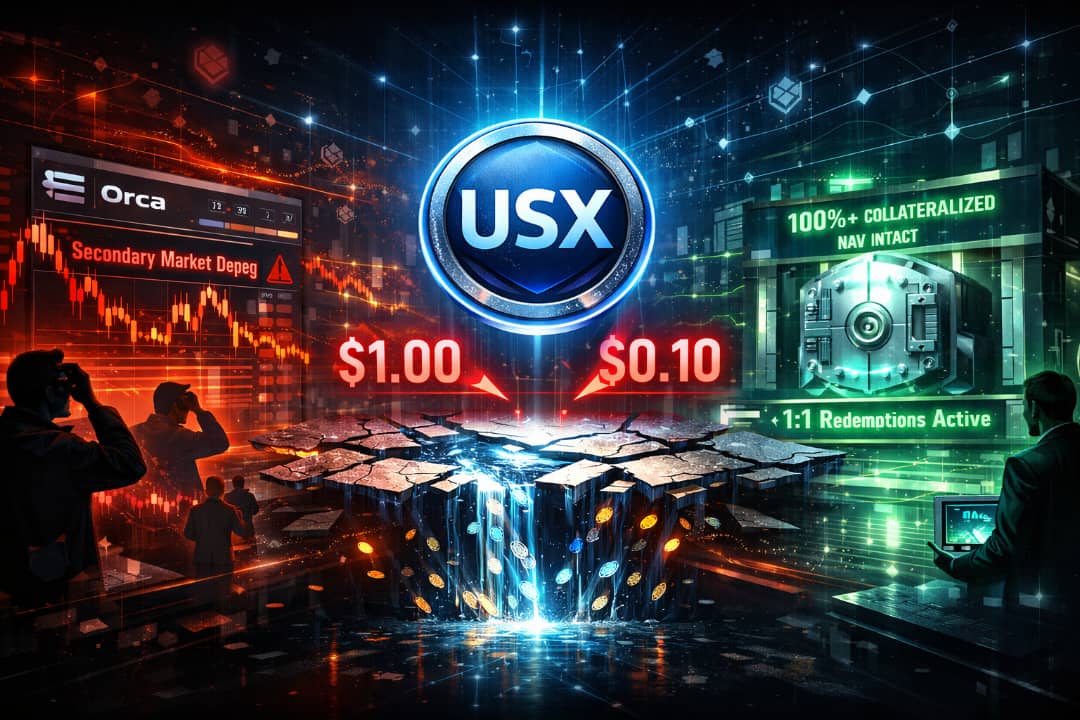
The Solana-based stablecoin USX experienced a sharp but temporary depeg overnight, dropping as low as $0.10 on secondary markets following a rapid liquidity drain.
The incident unfolded across decentralized exchanges, where selling pressure overwhelmed available liquidity and pushed prices far below the expected $1 peg.
Blockchain security firm PeckShield was among the first to flag the anomaly, pointing to abnormal price action tied to USX liquidity pools.
Within hours, the situation drew broader attention across the Solana ecosystem as traders scrambled to understand whether the move reflected a deeper solvency issue or a short-term market dislocation.
The price later rebounded to around $0.94 after Solstice, the issuer behind USX, stepped in and injected liquidity. The team quickly acknowledged the volatility and moved to calm fears of a broader collapse.
Solstice Confirms Backing Remains Intact
Solstice addressed the situation publicly on X, stating that while USX experienced “major volatility in the secondary market,” the underlying net asset value and custodied assets remain entirely unaffected.
https://twitter.com/solsticefi/status/2004426736792961079
According to the team, USX remains over 100% collateralized, and no issues were detected within Solstice’s internal systems. The event, they emphasized, was purely a secondary market liquidity issue, not a failure of reserves or protocol mechanics.
To reinforce transparency, Solstice requested an immediate third-party attestation report, which it plans to publish once available. The goal is to provide independent verification that the backing remains intact despite the temporary market disruption.
Most importantly, the team confirmed that 1:1 redemptions in the primary market remain fully available for authorized institutional partners.
What Triggered The Depeg
Solstice later released a detailed breakdown explaining exactly how the depeg unfolded.
Starting on December 26 at approximately 01:45 UTC, sell pressure on Orca and Raydium, two major Solana DEXs, began to exceed available liquidity. With thin depth in secondary pools, even moderate sell orders pushed prices sharply lower.
This dynamic worsened as traders reacted to falling prices, accelerating the move. At its lowest point, USX briefly traded near $0.10 on certain pools, far removed from its intended peg.
Crucially, this activity occurred entirely in secondary markets, where prices are determined by supply and demand rather than redemption mechanics. The core protocol was not impacted.
Solstice and its market-making partners began injecting liquidity around 04:30 UTC, and prices started recovering almost immediately. Since then, USX has continued trading closer to peg as depth returned.
Primary Vs Secondary Markets Explained
A key point in the incident is the distinction between primary and secondary markets, which Solstice emphasized repeatedly.
The primary market refers to direct minting and redemption through Solstice at a 1:1 ratio. This process is permissioned, requires KYC, and is typically used by institutional partners. During the volatility, primary redemptions remained fully functional.
The secondary market consists of decentralized exchange trading, where prices fluctuate based on liquidity and order flow. In low-liquidity conditions or during sudden sell-offs, secondary prices can diverge sharply from NAV, even when backing remains sound.
This divergence is exactly what occurred with USX. The peg broke on DEXs, not because reserves failed, but because liquidity temporarily vanished.
Not Another Algorithmic Collapse
As prices plunged, comparisons inevitably surfaced to past stablecoin failures. Solstice was quick to address that narrative head-on.
USX is not an algorithmic stablecoin. It is also not a rebasing token. Those designs failed historically because their backing collapsed or relied on reflexive mechanisms that unraveled under stress.
In contrast, Solstice maintains that USX backing never moved. Assets remained custodied and overcollateralized throughout the event. The issue was market structure, not solvency.
The team also clarified that eUSX and YieldVault products were entirely unaffected. Positions continued tracking strategy performance as expected, with no exposure to the secondary market dislocation.
Liquidity providers on Orca, Raydium, and Exponent may have experienced impermanent loss during the volatility, but their LP positions themselves remain intact.
What Happens Next For USX
With liquidity now restored and prices stabilizing, attention turns to prevention.
Solstice says it is actively working with both internal teams and external partners to deepen secondary market liquidity, reducing the risk that future large withdrawals or sudden sell pressure can cause similar dislocations.
For users who sold USX during the dip, Solstice was clear. Secondary market trades are final. There is no mechanism to reverse transactions executed at discounted prices. While the team acknowledged frustration, it emphasized that preventing recurrence is the priority.
For those who bought USX at distressed prices, no clawbacks apply. That activity represents legitimate arbitrage, with prices reflecting market conditions at the time.
The incident serves as a reminder of a broader truth in crypto markets. Even fully backed assets can experience sharp price swings when liquidity thins. Stability depends not just on reserves, but on market depth and infrastructure.
For now, Solstice maintains that the core system remains sound. The peg wobble was brief. Backing stayed intact. And the protocol continues operating as designed.
But the episode underscores how quickly confidence can be tested, and how critical transparent, rapid response has become in today’s on-chain financial markets.
Disclosure: This is not trading or investment advice. Always do your research before buying any cryptocurrency or investing in any services.
Follow us on Twitter @themerklehash to stay updated with the latest Crypto, NFT, AI, Cybersecurity, and Metaverse news!
