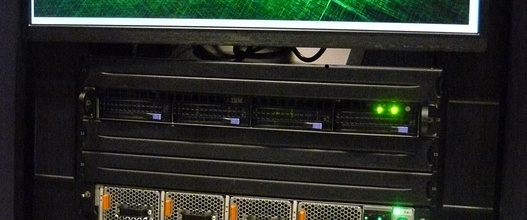
Supercomputers are the current hot trend in the technology sector. Countries are working hard on improving their supercomputers, even though they may not be accessible to the average consumer or business. Dutch scientists have built a compact supercomputer capable of achieving 0.2 petaflops of computing power. This goes to show one does not need data center-like storage solutions to house a supercomputer.
It is quite interesting to think of supercomputers as something that can come in a smaller size. While the mini-supercomputer still requires space equal to four 2U-rack servers, it is a far more compact example of a powerful machine than we have seen so far. Unfortunately, a smaller size also means the machine is far less powerful. Then again, 0.2 petaflops of computing power is not a laughable matter by any means.
Little Green Machine II, as this mini supercomputer is known as, will be made accessible to researchers in many different industries. Oceanography, artificial intelligence research, and astronomy are just a few industries which can benefit from such a small supercomputer. The end goal is to ensure researchers who have little to no experience with supercomputers will become enthusiastic about the prospect of working with more powerful hardware.
Under the hood, the Little Green Machine II uses two Power8 processors developed by IBM. Additionally, it uses four 4100-accelerator designed by Nvidia. On the software side, all communication occurs through Nvidia’s NVlink-interconnect. As a side effect of choosing this particular set of hardware, the mini-supercomputer is not only small but also incredibly power efficient.
One downside to using a completely different hardware and software structure compared to the first Little Green machine supercomputer is how researchers will need to rewrite their software. The researchers responsible for creating the mini-supercomputer are confident doing so will be more than worth the effort though. After all, the new model offers significant performance improvements, as it is ten times more powerful.
Image of the LGM2 Supercomputer
The primary objective of building a mini supercomputer it to provide flexibility wherever needed. There is no fixed quota associated with the device, and anyone can request a node to enjoy some extra computing resources. Once the device becomes popular among researchers, these agreements may need to be changed to allow fair use of the 0.2 petaflops of computing power, though.
It took the research roughly 200,000 EUR to build Little Green Machine II. While that is still a rather high price tag, it is a lot cheaper compared to any other supercomputer built so far. It will be interesting to see who will take up the offer to start using the mini-supercomputer in the future, and how it will influence researchers’ findings. In the end, it is good to see supercomputers can come in small sizes as well.
Image Source: 1
If you liked this article, follow us on Twitter @themerklenews and make sure to subscribe to our newsletter to receive the latest bitcoin, cryptocurrency, and technology news.
Velocity Ticket is trying to fix a major gap in businesses, and the approach it…
Axelar is moving fast to contain damage after identifying a security incident that has resulted…
suiUSDe now has a dedicated landing page. The token, officially the eSui Dollar, comes out…
Ventuals has fully wound down its HIP-3 DEX, and vHYPE withdrawals are now open. The…
Avalanche has launched the Avalanche Payments Collective, bringing together 28 organizations spanning nearly every layer…
A wallet tracked as 0x5f91 just opened a fresh 5x leveraged long on ASTER, putting…