
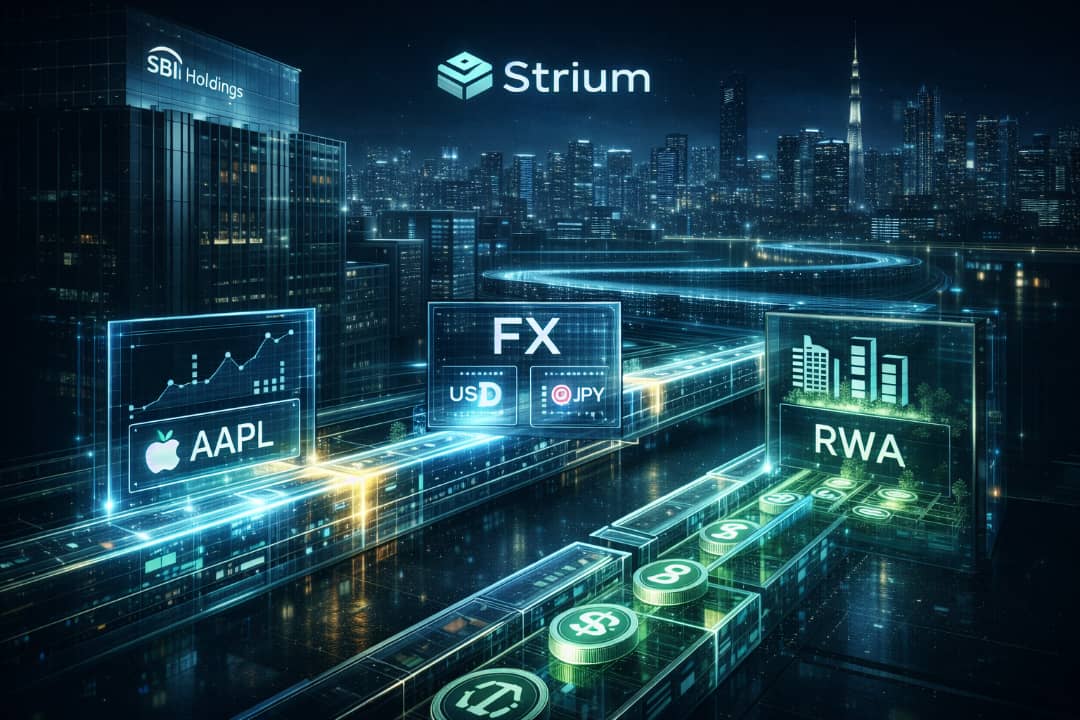
SBI Holdings and Startale Group have officially launched Strium Network, a new Layer 1 blockchain designed specifically for tokenized securities, institutional trading, and real-world assets (RWAs).
The network aims to become Asia’s exchange-layer infrastructure for compliant, onchain financial markets, bringing traditional assets like equities, FX, and real estate onto blockchain rails.
Strium positions itself at the intersection of regulated finance and decentralized infrastructure, leveraging SBI Holdings’ massive ecosystem of more than 80 million customers and decades of expertise across securities, banking, and financial services. With institutional-grade design at its core, the network seeks to bridge professional trading activity with real-world market participation onchain.
The official launch announcement was shared by Startale Group, outlining Strium’s vision for tokenized finance and regulated onchain markets:
Startale and SBI Holdings unveil Strium Network, a Layer 1 blockchain designed for 24/7 trading of tokenized securities and RWAs. pic.twitter.com/h2vxZXRHvh
— Startale 💿 (@StartaleGroup) February 5, 2026
A Layer 1 Built For Tokenized Securities And RWAs
Strium Network is not designed as a general-purpose blockchain. Instead, it focuses directly on the infrastructure required for tokenized securities, foreign exchange settlement, and real-world assets to operate securely and efficiently onchain.
The network serves as an exchange-layer blockchain, meaning it is built specifically to support high-volume institutional trading, compliance-driven settlement, and regulated asset issuance. Rather than adapting DeFi tools for institutional use, Strium starts from the needs of professional markets and builds blockchain infrastructure around them.
Tokenized securities allow traditional assets like stocks and bonds to exist as blockchain tokens, enabling real-time settlement, fractional ownership, and global accessibility. RWAs extend this further by bringing physical and financial assets, such as real estate, commodities, and revenue streams, into onchain environments.
Strium aims to provide the foundational rails that allow these assets to trade seamlessly within regulatory frameworks.
Leveraging SBI Holdings’ Massive Financial Ecosystem
One of Strium’s most powerful advantages lies in its connection to SBI Holdings, one of Asia’s largest financial conglomerates.
SBI operates across:
- Securities brokerage and asset management
- Banking and financial services
- Fintech platforms and digital finance
- Institutional trading infrastructure
With over 80 million existing customers, SBI brings immediate scale, liquidity potential, and institutional credibility to the Strium ecosystem.
This deep integration with traditional finance allows Strium to bridge:
- Institutional demand for compliant blockchain markets
- Professional trading activity across securities and FX
- Real-world asset participation through tokenization
Rather than building from scratch, Strium taps directly into a mature financial ecosystem already serving millions of users and institutions.
Institutional Trading And Onchain Settlement At The Core
Startale Group and SBI Holdings designed Strium specifically for institutional trading and settlement, two areas where traditional blockchains often struggle with compliance, scalability, and reliability.
The network supports:
- FX trading and settlement
- Tokenized equities
- Real-world asset issuance
- Regulated onchain financial products
By embedding settlement directly onchain, Strium aims to reduce friction, improve transparency, and enable faster capital movement compared to legacy financial systems.
This approach reflects a growing trend where blockchain is not replacing finance, but upgrading its infrastructure, offering real-time clearing, programmable compliance, and global market access.
Strium positions itself as the blockchain layer where regulated financial markets can operate efficiently without sacrificing security or legal oversight.
Starting With Tokenized Stocks And Expanding Under Regulation
Strium will initially support synthetic U.S. and Japanese stocks, allowing users to gain onchain exposure to traditional equities within regulatory frameworks.
Synthetic assets replicate the value of real-world securities through compliant financial structures, enabling blockchain-based trading while respecting legal boundaries.
Following the initial stock offerings, Strium plans to expand into broader tokenized real-world assets, including:
- Real estate-linked assets
- Financial instruments
- Structured products
- Other regulated RWAs
Each expansion will occur under established regulatory guidelines, ensuring long-term sustainability and institutional adoption rather than short-term experimentation.
A public testnet is also on the way, allowing developers, institutions, and market participants to explore Strium’s capabilities before full-scale deployment.
Connecting Traditional Finance With Onchain Markets
Strium’s core mission is to connect traditional financial markets directly to blockchain infrastructure.
Where legacy systems rely on slow settlement cycles, multiple intermediaries, and fragmented liquidity, Strium offers:
- Onchain settlement in real time
- Transparent transaction records
- Programmable financial logic
- Cross-border accessibility
By aligning these benefits with regulatory compliance and institutional standards, Strium removes many of the barriers that previously kept large financial players away from blockchain markets.
This creates a pathway for:
- Banks to issue tokenized assets
- Brokers to offer onchain trading
- Institutions to settle trades instantly
- Investors to access global markets digitally
Strium essentially transforms blockchain into a modern financial operating system for regulated markets.
A Major Step Forward For Asia’s Tokenized Economy
Asia has emerged as a major hub for digital asset innovation, fintech adoption, and institutional crypto infrastructure. Strium builds directly into this momentum by offering a blockchain designed for the region’s financial scale and regulatory landscape.
With SBI Holdings’ backing, Strium enters the market with:
- Immediate institutional relationships
- Deep liquidity potential
- Regulatory alignment
- Financial market expertise
Rather than competing with existing DeFi ecosystems, Strium complements them by focusing on regulated assets and institutional-grade trading, a segment expected to drive trillions in tokenized value over the coming decade.
Industry analysts increasingly view tokenized securities and RWAs as one of blockchain’s most impactful real-world use cases, unlocking liquidity, efficiency, and global access across traditional asset classes.
Strium positions itself directly at the center of this transformation.
The Future Of Regulated Onchain Finance Takes Shape
The launch of Strium Network represents a clear signal that blockchain infrastructure is moving beyond experimentation and into full-scale financial deployment.
By combining:
- SBI Holdings’ massive financial ecosystem
- Startale Group’s blockchain expertise
- Institutional trading infrastructure
- Regulatory-first design
Strium creates a platform where traditional finance and onchain markets converge seamlessly.
As tokenized securities, FX markets, and real-world assets increasingly shift onto blockchain rails, networks like Strium will form the backbone of tomorrow’s financial system, faster, more transparent, and globally accessible.
With public testing on the horizon and asset tokenization already underway, Strium is positioning itself as Asia’s gateway to regulated onchain finance and the next generation of digital capital markets.
Disclosure: This is not trading or investment advice. Always do your research before buying any cryptocurrency or investing in any services.
Follow us on Twitter @themerklehash to stay updated with the latest Crypto, NFT, AI, Cybersecurity, and Metaverse news!
