
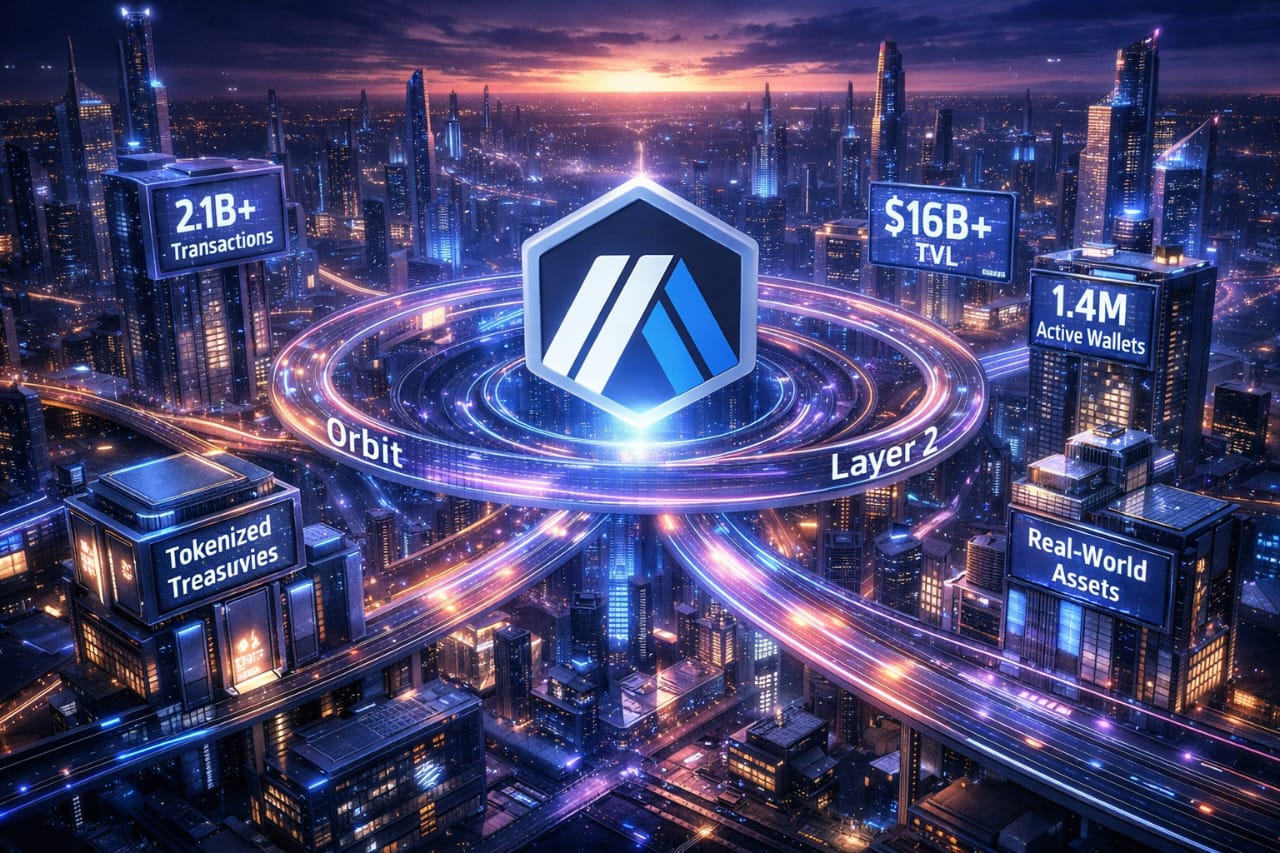
In 2025, Arbitrum completes a clear transition from being viewed as “just a fast Layer 2” to becoming one of the primary environments where real economic activity runs onchain.
What sets this year apart is not a single hype cycle or isolated metric, but the combination of sustained usage, deep liquidity, institutional adoption, and a rapidly expanding ecosystem of chains built on Arbitrum technology.
Throughout the year, Arbitrum demonstrates that Ethereum scaling does not have to be a tradeoff between performance and credibility. Crypto natives, DeFi power users, consumer platforms, and large institutions increasingly operate side by side on the same base infrastructure. By the end of 2025, activity on Arbitrum reshapes how the market thinks about Layer 2s and their role in Ethereum’s long-term roadmap, according to analysis shared publicly.
2025 was the year @arbitrum moved from being just a fast Layer 2 to becoming one of the main places where both crypto natives and big institutions actually ran real business onchain. Activity, liquidity, and new chains on top of Arbitrum all grew at a pace that changed how people… pic.twitter.com/Mwew0WUquW
— 0xsagar.base.eth. .ink (💙,🧡) (@sagar_ujjanwal) January 3, 2026
Network Scale And Liquidity Reach New Milestones
Arbitrum’s growth in 2025 is measurable, sustained, and difficult to ignore. Arbitrum One surpasses 2.1 billion lifetime transactions, adding its second billion in less than a year. At peak periods, the network processes several million transactions per day, reinforcing that this activity is not driven by short-lived incentives but by ongoing demand.
Active wallets climb to roughly 1.4 million, while Arbitrum maintains a dominant Layer 2 market share in the mid-30% to mid-40% range across major dashboards. These figures place it consistently ahead of competing Ethereum scaling solutions throughout the year.
Liquidity follows usage. Total value locked and secured on Arbitrum grows from roughly $8–12 billion earlier in 2025 to over $16 billion by November, with some datasets showing $19–20 billion by late year, depending on methodology. This rise reflects deeper capital commitment rather than speculative inflows, with stablecoins and longer-term DeFi positions accounting for a growing share of TVL.
Stablecoins And Onchain Credit Drive DeFi Maturity
One of the clearest signals of Arbitrum’s maturation in 2025 is the role stablecoins play on the network. Stablecoin balances reach multiple billions of dollars, with USDC holding the largest share. At the same time, newer designs gain traction, including USDai, treasury-backed assets such as thBILL, and yield-linked products like syrupUSDC.
DeFi on Arbitrum also evolves beyond spot trading and basic lending. Onchain credit expands sharply, with active loans rising above $1.5 billion and new lending products growing by several hundred percent over the year. This shift reflects growing confidence in Arbitrum as a place to run longer-duration financial strategies.
The Arbitrum DAO’s DRIP initiative plays a key role in this expansion. Tens of millions of ARB in incentives are directed toward borrowing and liquidity programs, helping stablecoin balances and lending volumes grow at triple-digit rates while avoiding the boom-and-bust patterns seen in earlier DeFi cycles.
A Layered Ecosystem Of Chains And Builders
By 2025, Arbitrum is no longer just a single network. It becomes a broader platform for launching customized chains through Orbit and Layer 3 deployments. More than 100 chains are live or in development, ranging from specialized perpetuals exchanges and privacy-focused projects to consumer-facing applications.
This layered structure allows teams to design purpose-built environments while still benefiting from Ethereum security and Arbitrum liquidity. As a result, the ecosystem grows not only in size but in depth. By year-end, well over 1,000 projects are tied into Arbitrum, spanning large DeFi protocols, automated strategy platforms, real-world asset rails, and developer tooling.
Community building supports this expansion. Hackathons, regional events, and in-person initiatives, particularly in markets such as India, bring new builders into the ecosystem, reinforcing Arbitrum’s reputation as a practical place to ship production-grade applications.
Institutions And Real-World Assets Move Onchain
One of the most important shifts in 2025 is the way traditional finance begins using Arbitrum for real products rather than experiments. Large asset managers launch tokenized treasury funds and money-market-style products directly on the network, giving onchain users exposure to US government debt within familiar DeFi frameworks.
The Arbitrum DAO’s STEP 2.0 initiative commits approximately 35 million ARB to real-world asset efforts. This includes support for tokenized Treasury offerings such as WisdomTree’s WTGXX, Spiko’s USTBL, and Franklin Templeton’s BENJI. Notably, Spiko surpasses $200 million in assets on Arbitrum within its first year, highlighting real demand for these products.
Beyond finance, Arbitrum also supports use cases like publishing economic data onchain and powering stock access products, often operating invisibly beneath traditional-looking interfaces while settling on public infrastructure.
Revenue, Timeboost, And A Stronger DAO Balance Sheet
Financially, Arbitrum closes 2025 in a stronger position than many other networks. The ecosystem achieves gross margins above 90% across four revenue streams, driven by high usage and relatively low operating costs as a Layer 2.
A key protocol-level change during the year is Timeboost, a new transaction ordering policy that introduces a transparent way for users to bid for execution priority while preserving predictability for everyday transactions. In roughly its first seven months, Timeboost generates over $5 million in revenue, contributing to an annualized DAO gross profit of around $26 million by Q4 2025.
The DAO also strengthens its balance sheet, holding over $150 million in non-native assets, including ETH and cash equivalents. This diversification provides flexibility to fund long-term ecosystem investments without relying solely on token sales or inflation.
Liquidity Leadership And The Pendle Effect
By late 2025, Arbitrum’s liquidity leadership becomes even clearer. With over $460 million in TVL on Pendle, Arbitrum pulls ahead of every other Layer 2 in TVL market share, swap volume, and fees. This marks a structural shift in where yield-focused liquidity chooses to operate.
Much of this growth comes from emerging protocols rather than recycled capital. Over a three-month period, USDai and Theo Network drive a 5× increase in Arbitrum’s TVL on Pendle, signaling strong product–market fit and genuine demand for yield strategies.
With $460M+ in TVL on @pendle_fi , @arbitrum has now pulled ahead of every other L2 in market share across TVL, swap volume, and fees. This isn’t just incremental growth it’s a clear shift in where liquidity is choosing to live.
What’s especially notable is where this growth is… pic.twitter.com/DckD888UVP
— 0xsagar.base.eth. .ink (💙,🧡) (@sagar_ujjanwal) January 2, 2026
Crucially, DRIP’s sustainable incentive structure helps ensure this liquidity is durable. Instead of mercenary capital chasing short-term rewards, Arbitrum sees liquidity deepen and persist, reinforcing a powerful flywheel of more protocols, more users, more volume, and more fees.
Looking Toward 2026
By the close of 2025, Arbitrum stands as a network where everyday users, DeFi natives, and large institutions coexist on shared infrastructure without friction. With more chains launching on Arbitrum technology, continued real-world asset expansion, and upgrades like Stylus and further decentralization on the roadmap, the foundation is set for another defining year.
Rather than reacting to market trends, Arbitrum enters 2026 positioned to help shape where onchain activity goes next, and to do so at real scale.
Disclosure: This is not trading or investment advice. Always do your research before buying any cryptocurrency or investing in any services.
Follow us on Twitter @themerklehash to stay updated with the latest Crypto, NFT, AI, Cybersecurity, and Metaverse news!
