
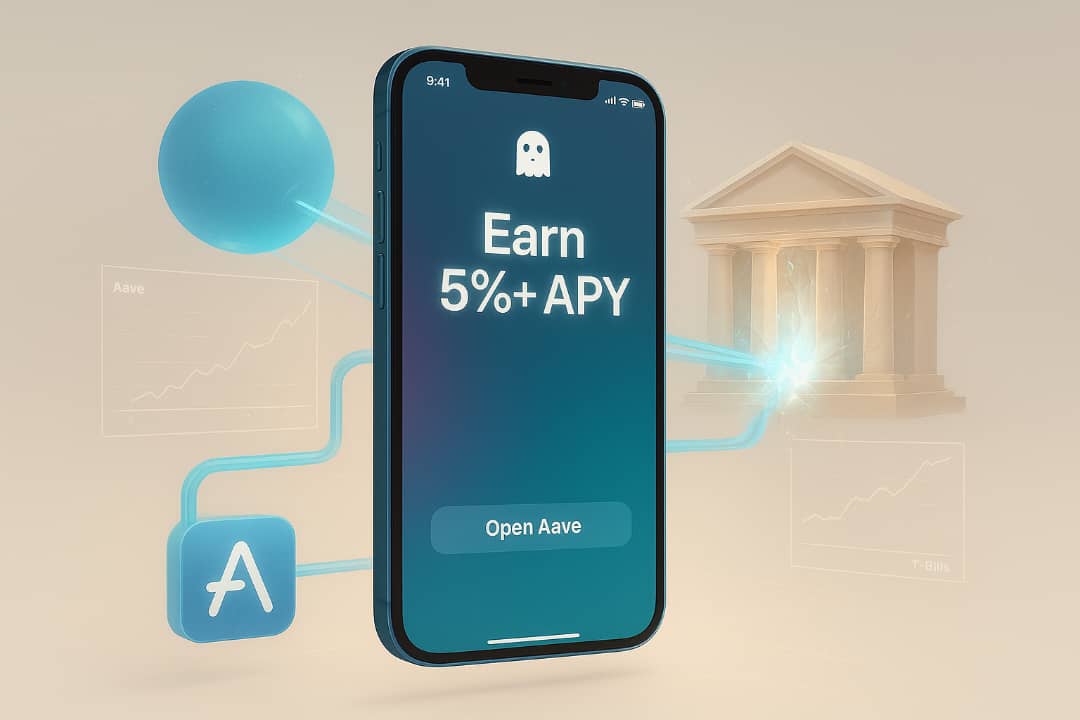
The DeFi giant has announced the launch of the Aave App on Apple’s App Store, marking one of the most direct pushes yet from crypto into traditional consumer finance.
The app now has an early-access waitlist, and demand began piling up within hours of the reveal.
The product is simple by design. Users can deposit funds using a bank account or debit card and earn yields starting at 5%. Aave positions it as a crypto-powered alternative to savings accounts, except with higher returns and no legacy banking overhead.
The app runs on stablecoins and the Aave protocol under the hood. To the average user, it looks like a high-yield savings app. To the industry, it signals something bigger: DeFi stepping into the same field as commercial banks and neobanks with a structurally better value proposition.
Aave Steps Into Retail Banking Territory
Aave’s announcement immediately sparked reactions across the crypto economy. With a sleek mobile interface and yields that beat most savings products globally, the protocol is now challenging the traditional system in open daylight.
Sealaunch Intelligence captured the sentiment clearly in its analysis: Aave isn’t just offering competitive yields, it’s offering consistently superior yields compared to traditional low-risk benchmarks.
The question now is whether traditional finance can still rely on interest-rate cycles to maintain its advantage. Initial data suggests the answer is no.
Aave vs. T-Bills: The Numbers Tell the Story
Sealaunch evaluated Aave stablecoin APYs across three key macro environments:
- Low-rate period (Jan 2021 – Mar 2022): When the Fed held near zero.
- High-rate period (Jul 2023 – Sep 2024): The era of peak tightening at 5.25–5.50%.
- Mid-high period (Sep 2024 – Oct 2025): A transition period as the Fed started cutting, but rates stayed above historic averages.
Across all three regimes, Aave’s stablecoin yields outperformed T-bills, money market rates (MMR), and the Not-So-Risky (NSR) benchmark on average.
Introducing Aave App, a smarter way to save. pic.twitter.com/HaseIjnWW5
— Aave (@aave) November 17, 2025
The pattern is clear:
- T-bills occasionally beat Aave.
- But those moments were brief, narrow, and rare.
- The stretches where Aave led were longer and produced larger yield spreads.
As Sealaunch put it:
“The valleys are smaller than the peaks.”
That structural gap is why Aave maintains a higher long-term average when compared to TradFi’s safest benchmark.
And timing matters.
T-bill yields are expected to fall into their lowest range in two to three years. Aave’s consistent outperformance becomes even more relevant in the months ahead.
The EUR Side Tells the Same Story
Aave’s EUR markets tell a nearly identical story to its USD markets.
Although EUR stablecoins were added more recently, the relationship is unmistakable:
- Aave APYs trend 1–2% above ESTR, Europe’s short-term interest rate benchmark.
- Different currencies.
- Different rate environments.
- Same outcome.
- Aave keeps a persistent yield premium.
This consistency is a structural advantage, not a lucky macro run.
Why This Matters for the Aave App
Aave’s new mobile app brings these historically higher yields into a consumer-friendly interface.
- No charts.
- No wallet setup.
- No learning curve.
Just an app, a deposit button, and a yield.
For everyday users, the pitch is straightforward:
- Banks offer <1–3% in most regions.
- T-bills offer 3–5% but require brokerage access.
- Aave offers 5%+ directly from a phone.
- That changes the competitive landscape.
For the first time, depositors can compare banks and DeFi side-by-side without needing to understand crypto at all.
The app’s arrival also confirms a long-running thesis across Web3:
DeFi is not just a parallel financial world, it’s increasingly a replacement for the lower-yield segments of legacy finance.
Aave’s Positioning: DeFi With a Real Consumer Edge
Aave is also leaning heavily into narrative.
The protocol has been preparing for this moment for years:
- A battle-tested lending system
- A strong safety-module backstop
- Reinforced stablecoin markets
- A maturing layer of institutional integrations
What used to be a niche DeFi product is now crossing into mass-market territory.
With the announcement of Aave App, @aave directly competes with banks (and neo banks) by offering a better yield on deposits to the common user.
But how competitive are Aave rates historically?
We analysed Aave stablecoin APYs and compared with T-Bills across three… https://t.co/HiQxWcPlo7 pic.twitter.com/GDkDMRa7u9
— sealaunch intelligence (@sealaunch_) November 17, 2025
- The timing is deliberate.
- Global rates are falling.
- Bank yields will follow.
- Money market funds will compress.
Aave’s yields, historically, do not compress at the same pace.
This gives the app a powerful differentiator:
- A persistent yield advantage with global accessibility.
Aave’s Launch Signals the Next Wave of DeFi Adoption
Beyond yield, Aave’s announcement is significant for another reason:
- It represents the next chapter of crypto apps going mainstream without requiring users to understand crypto at all.
- The DeFi backend becomes invisible.
- The user sees a savings product.
- The blockchain does the work.
- This is exactly the model that turned neobanks into global players.
Now DeFi is adopting the same playbook, except with stronger economics.
And with the Aave App, millions of iPhone users gain direct access to a yield engine that historically outperforms the safest assets in traditional finance.
A Structural Shift in Value
Across every monetary regime, currency pair, and benchmark analyzed, the result remains the same:
- Aave yields exceed traditional low-risk alternatives.
- The premium is consistent, not cyclical.
- The launch of the Aave App now opens that premium to everyone.
DeFi wins when it offers a better deal.
Today, it does.
And with the Aave App going live, the line between savings accounts and decentralized finance just got a lot thinner.
Disclosure: This is not trading or investment advice. Always do your research before buying any cryptocurrency or investing in any services.
Follow us on Twitter @themerklehash to stay updated with the latest Crypto, NFT, AI, Cybersecurity, and Metaverse news!
