
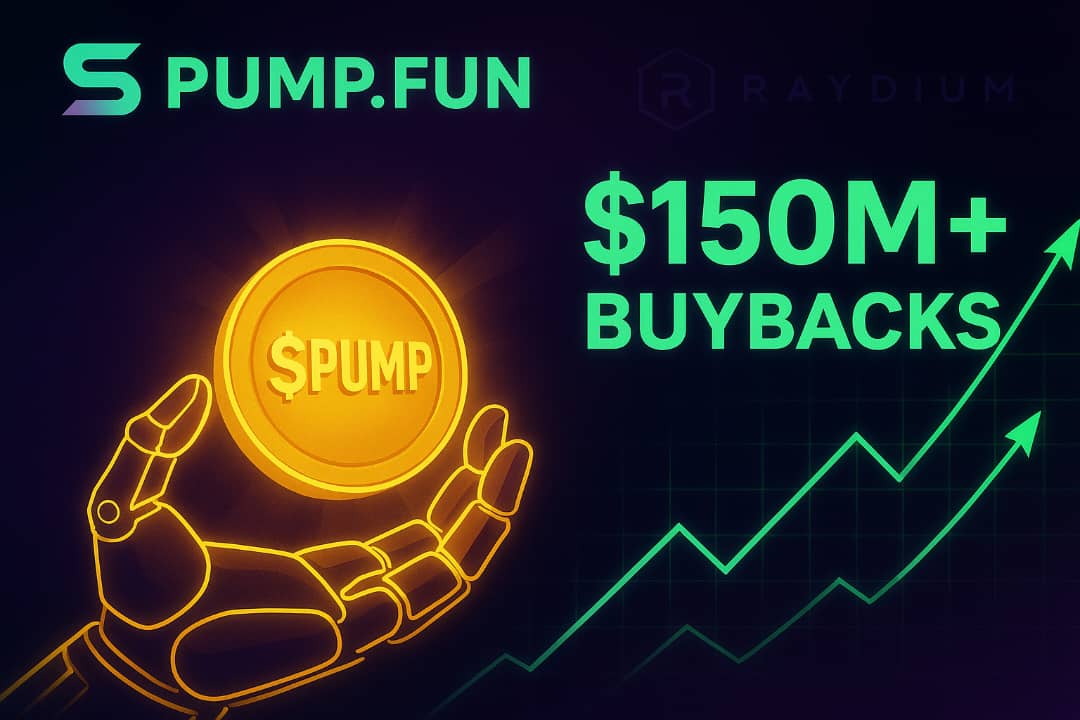
Pump.fun just hit a massive milestone. The project’s buybacks of the $PUMP token have surpassed $150 million, with 9.4% of total supply already repurchased in just over three months.
That makes Pump.fun only the second Solana project to ever reach this level, the first being Raydium (@Raydium), which has completed over $200 million in lifetime buybacks.
It’s a powerful statement for Solana’s growing on-chain economy and a signal that revenue-backed models are taking center stage again in crypto.
The Power of Buybacks in Crypto
In traditional markets, companies buy back their own shares to increase shareholder value.
Crypto projects do something similar, only faster, and transparently on-chain.
When a platform earns revenue, it can use part of it to buy back tokens from the open market.
That reduces supply, supports price stability, and directly reflects how well the platform is performing.
For long-term investors, this is one of the strongest fundamentals to watch.
Projects that generate consistent revenue and use it for buybacks tend to show sustainable token strength over time.
And that’s exactly what we’re seeing now with Pump.fun and a few standout protocols across the ecosystem.
Pump.fun, The Revenue Machine
Pump.fun started as a memecoin launch platform on Solana.
Now it’s one of the highest-earning on-chain businesses in the ecosystem.
Its model is simple: every token launched pays a small fee, and the platform earns revenue from that constant stream of activity.
As of now, Pump.fun’s buyback total exceeds $150 million, repurchasing nearly one-tenth of its entire supply.
For comparison, few DeFi or trading protocols across any blockchain have achieved that scale in such a short time.
That buyback number alone places Pump.fun alongside Solana’s biggest names, second only to Raydium, the long-standing DEX with over $200 million in total buybacks over its lifetime.
This shows the strength of Solana’s on-chain liquidity and how memecoin platforms have evolved into serious economic drivers within the ecosystem.
Why Buybacks Matter
Token supplies in crypto are variable.
Inflation, emissions, and unlocks often weigh on token prices.
Buybacks act as a counterweight, a way to absorb supply and stabilize value.
When a project’s revenue grows, it gains the power to consistently buy back tokens, effectively linking price performance to actual business output.
That’s what separates sustainable tokens from hype-driven ones.
Hyperliquid and Pump.fun have recently shown how well this model can work.
Both platforms run with strong revenue inflows, and both are executing significant buybacks that strengthen token confidence.
These are signs of maturity across DeFi, a shift toward revenue-aligned token economies.
The Long-Term View
Of course, not every project can sustain this.
Many tokens, even promising ones, eventually succumb to supply growth, emissions, staking rewards, or token unlocks overwhelm their buyback power.
It’s a pattern that’s played out countless times before.
That’s why revenue remains the most critical factor in long-term crypto investment.
Tokens without cash flow eventually rely on speculation alone.
Tokens with revenue can support real, repeatable demand.
As buyback programs scale, they not only defend token prices but also build a feedback loop, the more users interact with the platform, the more revenue it earns, and the stronger the buybacks become.
Pump.fun, Hyperliquid, and the “Revenue Era”
Between Pump.fun and Hyperliquid, the conversation in crypto is shifting back to revenue-based valuation, something that used to define traditional equity markets.
These projects are proving that on-chain platforms can operate like real businesses:
- They generate fees.
- They sustain buybacks.
- They give value back to holders.
This evolution could define the next major narrative in DeFi, one centered not on speculation or liquidity mining, but on cash flow and buyback economics.
What It Means for Solana
For Solana, this is a major credibility boost.
Projects like Pump.fun and Raydium are showing how active ecosystems can monetize usage at scale.
With over $350 million combined in lifetime buybacks, these two platforms alone have created a benchmark for real revenue generation in the blockchain space.
And with Solana’s ultra-low fees and high throughput, it’s clear why it’s becoming the preferred home for revenue-driven on-chain projects.
The next step will be how these projects scale further.
Can Pump.fun sustain its buyback pace over the next six months?
And can Hyperliquid keep its edge as perp trading heats up across L2s?
If these projects continue to prove that real revenue equals real value, we may be witnessing the start of a more mature phase for crypto, one where fundamentals finally matter again.
Pump.fun’s $150 million buyback milestone isn’t just a stat, it’s a signal.
Revenue-backed crypto projects are thriving again, and investors are starting to notice.
As supply-heavy projects fade, platforms with strong revenue and aggressive buybacks are likely to dominate the next market cycle.
And Pump.fun is leading that charge, one buyback at a time.
Disclosure: This is not trading or investment advice. Always do your research before buying any cryptocurrency or investing in any services.
Follow us on Twitter @themerklehash to stay updated with the latest Crypto, NFT, AI, Cybersecurity, and Metaverse news!
